CMI Command Verbs Explained — What Every Verb Requires at Each Level
Every CMI assignment is governed by a command verb. The verb is the instruction word in your unit’s Learning Outcome that tells you exactly what cognitive process the assessor is marking. Getting the content right but misreading the verb is one of the most common causes of CMI resubmissions. This guide covers every command verb used across CMI Levels 3 to 7 — what each one means in assessment terms, how it differs from similar verbs, what a compliant response includes, and which levels use it most.
Not sure what your command verb requires? Message us on WhatsApp.
Send your Learning Outcome and we will confirm exactly what your response needs to include.
What Are CMI Command Verbs and Why Do They Matter?
CMI command verbs appear in the Learning Outcomes of every CMI unit. They define the minimum cognitive process required for a pass, and the depth of that process determines whether a response reaches Merit or Distinction. The assessor does not mark whether you know about a topic — they mark whether you have applied the correct cognitive process to it.
A student who knows transformational leadership theory thoroughly but Describes it when the task says Evaluate will not pass. A student who Evaluates clearly with named criteria and supported conclusions will pass, and may achieve Merit or Distinction depending on the depth of application.
The verb is the instruction. The topic is what you apply it to. Both matter, but the verb defines the standard.
Where Command Verbs Appear in CMI Assignments
Command verbs appear in two locations in every CMI unit: the Learning Outcome statement and the Assessment Criteria. The Learning Outcome states what the learner will be able to do (“Evaluate the impact of leadership styles on team performance”). The Assessment Criteria describes how the assessor marks it (“The learner can evaluate leadership styles against defined criteria with supporting evidence”).
Both must be read together. The verb in the Learning Outcome defines the process; the Assessment Criteria defines what entity the process is applied to and at what standard. Students who read the topic and ignore the verb write about the right thing in the wrong way. Read the verb first, then build your response around it.
The CMI Command Verb Cognitive Depth Ladder
CMI command verbs form a cognitive hierarchy. Lower-order verbs require knowledge and understanding. Mid-order verbs require application and analysis. Higher-order verbs require synthesis, judgement, and the ability to question frameworks as well as use them. Each higher verb contains the lower ones within it — to Critically Evaluate, you must first Identify, then Analyse, then Evaluate, then challenge the evaluation framework itself.
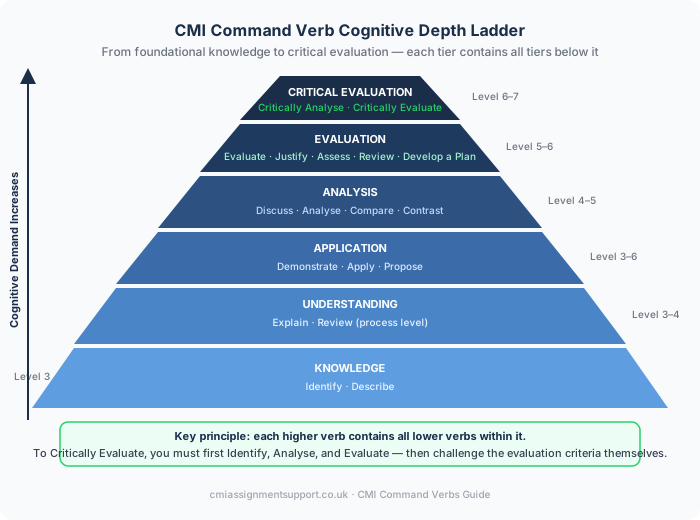
The practical implication: a Merit response at Level 5 meets Evaluate at a consistent level with evidence and criteria. A Distinction response applies Critically Evaluate — even if the Learning Outcome only states Evaluate — by acknowledging the limitations of the criteria used. Understanding where your required verb sits on this ladder tells you how much further you need to go.
Every CMI Command Verb — Definition, Depth, and How to Answer
Identify
What it means in CMI assessment: Name or list specific items, factors, examples, or features. No explanation is required — identification is sufficient.
What it does not mean: A detailed discussion. Students often expand Identify answers into explanations, which dilutes focus and wastes word count.
What a compliant response includes: A clear, specific list or statement that names the required items with enough specificity to show genuine knowledge. Generic naming (a “leadership model”) is weaker than specific naming (“Kotter’s 8-Step Change Model”).
Response starter: “Three factors that affect team cohesion in a dispersed workforce are: (1) frequency of structured communication, (2) clarity of shared goals and individual roles, and (3) access to collaborative working tools.”
CMI levels: Most common at Level 3. Appears in Level 4 pass criteria.
Describe
What it means in CMI assessment: Provide the characteristics, features, or sequential steps of something. What it looks like, what it consists of, or how it works — in enough detail to demonstrate genuine familiarity with it.
What it does not mean: A single-sentence definition. Describe requires more than a dictionary entry. It also does not require reason or cause — that is Explain.
What a compliant response includes: Named features or stages with specific detail. For a leadership model, name the specific behaviours — not just “focuses on motivation” but the specific motivational mechanisms the model describes.
Response starter: “Transformational leadership is characterised by four behaviours: idealised influence, in which the leader acts as a role model; inspirational motivation, in which the leader articulates a clear vision; intellectual stimulation, in which the leader encourages creative thinking; and individualised consideration, in which the leader attends to each team member’s development needs.”
CMI levels: Most common at Level 3. Occasionally in Level 4 pass criteria.
Explain
What it means in CMI assessment: Give the reason why something is the case, or describe how a process works with the reasons at each step. Explain answers WHY — not just WHAT.
What it does not mean: A description. Students frequently describe when asked to explain, producing the right topic with none of the cause-and-effect reasoning the verb requires.
What a compliant response includes: A cause-and-effect relationship, a process with reasons at each stage, or a reasoned account of why a factor operates as it does. The word “because” is a reliable signal that Explain is being met.
Response starter: “Tuckman’s model moves from the Forming to the Storming stage because the initial absence of established team roles and norms creates interpersonal friction as members negotiate their positions and test the boundaries of the group’s working arrangements.”
CMI levels: Level 3 at merit grade. Level 4 at pass grade.
Discuss
What it means in CMI assessment: Present a balanced argument — consider multiple perspectives or positions with supporting evidence for each, then reach a reasoned conclusion. There is no single correct answer in a Discuss response.
What it does not mean: Write everything you know about a topic. Students often interpret Discuss as an invitation to be comprehensive rather than balanced. A Discuss response is an argument, not a survey.
What a compliant response includes: A minimum of two distinct perspectives, each supported by evidence. A synthesis or conclusion that takes a reasoned position without dismissing the alternative view. The balance must be genuine — a brief acknowledgement of one side followed by extended advocacy of the other does not meet the verb.
Response starter: “There are competing perspectives on the effectiveness of financial incentives as a motivational tool. Herzberg’s Two-Factor Theory suggests that pay functions as a hygiene factor rather than a true motivator — preventing dissatisfaction rather than producing engagement. By contrast, expectancy theory (Vroom, 1964) argues that the expectation of a valued reward — which may be financial — is the primary driver of motivated behaviour. Considering the evidence from both frameworks in the context of…”
CMI levels: Levels 3 and 4.
Analyse
What it means in CMI assessment: Break the subject of the task into its component parts and examine how those parts relate to each other and to the management context. Analyse requires relationships between components, not just a list of them.
What it does not mean: Describe in detail. Students frequently produce highly detailed descriptions of management theories and believe this constitutes analysis. Description answers WHAT. Analysis answers HOW and WHY components interact.
What a compliant response includes: Named components, an explanation of each component’s function, an examination of how components interact with each other, and a statement about what this relationship reveals about the management topic in question.
Response starter: “An analysis of the barriers to effective communication in the organisation reveals three interacting factors. First, the hierarchical reporting structure limits upward information flow because team members have limited direct access to senior decision-makers. This connects to the second barrier — a meeting culture weighted toward downward communication — which compounds the first by providing few formal mechanisms for staff-initiated input. Together, these structural factors produce the third barrier: informal communication channels that carry significant information but lack accountability or consistency.”
CMI levels: Level 4 at merit and distinction. Appears in Level 3 distinction criteria. Level 5 as a component of more demanding verbs.
Evaluate
What it means in CMI assessment: Apply named criteria to assess the strengths and weaknesses or effectiveness of something, and reach a supported conclusion. Evaluate requires explicit criteria — not just a list of pros and cons.
What it does not mean: A pros-and-cons list, a description of both sides of an argument, or a thorough analysis. These are common substitutes that fall short. Evaluate requires the student to NAME the criteria being used to judge, then APPLY them, then REACH a conclusion about merit or effectiveness.
What a compliant response includes: Named evaluation criteria (for example: effectiveness in a crisis, long-term sustainability, applicability to diverse teams, cost of implementation). Application of each criterion to the subject with evidence. A conclusion that states what the evaluation reveals and supports that finding with the evidence applied.
Response starter: “Evaluating transformational leadership against three criteria — motivational effectiveness, applicability in operational management roles, and sustainability under high workload — reveals the following. Against motivational effectiveness, the research evidence (Bass and Riggio, 2006; Judge and Piccolo, 2004) consistently supports a positive relationship with intrinsic motivation and team engagement. Against applicability in operational roles, the model’s requirement for sustained visionary communication presents a limitation in contexts where managers have limited autonomy over direction-setting. Against sustainability, evidence from Barling et al. (2000) indicates that…”
CMI levels: Core verb at Level 5. Appears in Level 4 distinction criteria. Also appears in Level 6 and 7 alongside Critically Evaluate.
Justify
What it means in CMI assessment: Provide evidence-based reasoning to support a chosen decision, recommendation, or position. The argument must be grounded in external evidence — theory, data, legislation, or research findings — not in personal preference or experience alone.
What it does not mean: Explain why you chose something, or state that in your experience an approach works. Personal justification is not academic justification.
What a compliant response includes: A clear position or recommendation, external evidence that supports it from at least two independent sources, acknowledgement and rebuttal of the strongest counter-argument, and a reinforced conclusion.
Response starter: “The recommendation to introduce a structured 90-day onboarding programme for newly promoted managers is justified by three converging evidence sources. First, research by Watkins (2013) demonstrates that managers who receive structured transition support are significantly less likely to underperform in their first year. Second, the CIPD (2022) People Development Report indicates that organisations without formal manager onboarding report higher rates of team disengagement within six months of a management transition. Third, the organisation’s own exit interview data from 2023 shows that…”
CMI levels: Core verb at Level 5, paired frequently with Evaluate. Appears in Level 6 and 7 alongside Critically Evaluate.
Assess
What it means in CMI assessment: Use a named framework or set of criteria to judge the current state, quality, or performance of something. Assess is applied to an existing situation — measuring it against a benchmark or standard.
What it does not mean: Describe the current situation. Assess requires a framework to measure against — without a named standard, the response is description.
What a compliant response includes: A named assessment framework (SWOT analysis, balanced scorecard, CMI competency standards, relevant legislation), application of the framework to the specific situation being assessed, and a judgement about what the assessment reveals — including gaps, strengths, and areas requiring action.
Response starter: “Assessing the team’s performance against the CMI Management Standards reveals two areas of strength and two significant gaps. In relation to Standard 2 (Leading People), the team consistently meets task completion targets, as evidenced by Q3 operational data. However, against Standard 4 (Building Capability), the absence of structured development conversations and a skills gap in data analysis indicate…”
CMI levels: Levels 5 and 6. Most common in performance management, risk, and operational planning units.
Review
What it means in CMI assessment: Systematically examine something against a stated purpose, goal, or standard to determine what is working, what is not, and what needs to change. Review implies currency — it concerns the present state — and action-orientation.
What it does not mean: A historical account of what happened. A Review is not a narrative — it examines the current state against a goal and identifies change requirements.
What a compliant response includes: A statement of what is being reviewed and against what standard. A structured assessment of the current state against that standard. Identification of what meets and what falls short. Recommendations for change arising from the review.
Response starter: “A review of the organisation’s talent development programme against its stated objective of building internal succession pipelines reveals three areas of misalignment. The programme prioritises technical skill development at the expense of leadership capability, meaning that high-potential employees are well prepared for specialist roles but not for management transitions. Furthermore…”
CMI levels: Levels 5 and 6. Common in performance management, talent management, and strategic planning units.
Develop a Plan
What it means in CMI assessment: Produce a specific, actionable plan with named objectives, responsible parties, resources required, timelines, and success measures. The output must be a plan — not a description of what a plan would contain.
What it does not mean: A narrative account of how you would approach planning. Writing “I would begin by identifying objectives and then consulting stakeholders…” is describing planning, not producing a plan.
What a compliant response includes: SMART objectives for each planned action, named accountability, resource requirements, a milestone timeline, and measurable success criteria. The plan should be structured in a format a manager could take and action — typically a table with columns for Objective, Action, Responsible, Timeline, Resource, and Success Measure.
CMI levels: Core verb in operational and professional development planning units at Levels 5 and 6. Appears in strategic planning units at Level 7.
Propose
What it means in CMI assessment: Put forward a specific, actionable recommendation with a supported rationale. The proposal must be concrete enough to implement and grounded in the evidence presented in the preceding analysis.
What it does not mean: A conceptual suggestion. “The organisation should improve communication” is a direction, not a proposal. A proposal names the specific action, the rationale, and the expected benefit.
What a compliant response includes: A named, specific proposal. The evidence or analytical reasoning that supports it. Anticipated benefits and any risks or conditions. Sufficient specificity that a manager could action it without further clarification.
Response starter: “This report proposes the implementation of a structured 12-week coaching programme for all newly promoted team leaders, delivered by internal CMI-qualified managers. The programme would consist of four modules aligned to CMI Level 5 unit competencies, delivered via a blended learning format combining group workshops and one-to-one coaching sessions. Justification for this specific approach rests on…”
CMI levels: Levels 5 to 7. Often encountered in the recommendations section of management reports at all these levels.
Critically Analyse
What it means in CMI assessment: Perform a full analysis — breaking components apart and examining their relationships — AND explicitly identify the limitations, assumptions, and gaps in that analysis. The “critical” prefix means challenging the analytical framework itself, not just applying it more thoroughly.
What it does not mean: A very thorough Analyse response. A student who decomposes a management theory into exceptional detail and explains every component relationship has produced excellent Analysis — but not Critical Analysis. The critical dimension requires asking: what does this framework NOT show? What assumptions does it make? What would an alternative framework reveal?
What a compliant response includes: A full component analysis with relationship mapping. Explicit statements about the limitations of the frameworks or evidence used. Reference to at least one alternative theory or perspective that challenges the primary analysis. A conclusion that acknowledges the partial nature of any analytical frame.
Response starter: “An analysis of the PESTLE framework applied to the organisation’s market entry strategy reveals [components and relationships]. However, this analysis carries significant limitations. PESTLE treats political and economic factors as analytically discrete when, in practice, changes in trade policy produce immediate economic consequences that the model does not capture dynamically. Furthermore, the framework is static — it maps the current external environment but does not model how factors interact over time. An alternative approach using scenario planning methodology (Schoemaker, 1995) would reveal…”
CMI levels: Levels 6 and 7. May appear in Level 5 distinction criteria for specific units.
Critically Evaluate
What it means in CMI assessment: Perform a full Evaluation — apply named criteria, reach a judgement — AND challenge whether those criteria are the right measure. Critically Evaluate requires the student to question the appropriateness and sufficiency of the evaluation framework itself.
What it does not mean: An unusually thorough Evaluation. The critical dimension is not about volume or depth of evidence — it is about stepping outside the evaluation to question its foundations.
What a compliant response includes: Named evaluation criteria applied in full with evidence. A conclusion reached. An explicit challenge to whether those criteria are appropriate, complete, or the best available measure. Alternative criteria that would produce a different judgement, and why. A final position that acknowledges the evaluative limitations while still reaching a defended conclusion.
Response starter: “Evaluating the leadership development programme against criteria of participant satisfaction, observed behaviour change, and productivity metrics reveals a largely positive picture — [criteria applied, judgement reached]. However, critically, these criteria measure observable and short-term outcomes rather than underlying leadership capability development. Participant satisfaction is known to correlate weakly with learning transfer (Kirkpatrick and Kirkpatrick, 2006). Alternative criteria — such as 360-degree leadership assessment scores at six-month intervals, or retention rates among direct reports — would provide a more robust measure of development effectiveness. Evaluating against these criteria, the evidence suggests…”
CMI levels: Standard expectation at Level 7. Required for Distinction at Level 6. Appears in some Level 5 distinction descriptors.
Command Verbs and CMI Grades — Pass, Merit, Distinction
Grade outcomes at all CMI levels are determined primarily by how well the student meets the command verb at the required cognitive depth. Understanding the grade implications of each verb helps writers calibrate the depth of their response.
| Grade | What the Assessor Looks For |
|---|---|
| Pass | The student CAN [verb] [topic] — the verb has been met at a basic level with appropriate content |
| Merit | The student demonstrates [verb] consistently with supporting evidence, relevant theory applied, and a clear line of reasoning |
| Distinction | The student demonstrates [verb] with critical awareness — acknowledging limitations, engaging with alternative perspectives, and defending a position against competing views |
What Assessors Look For in Each Grade Band
A Pass response demonstrates that the required cognitive process has occurred. For Evaluate, this means criteria have been named and the subject has been measured against them. For Justify, this means external evidence has been used to support a position.
A Merit response demonstrates consistent application with quality evidence. Criteria are well-chosen, theory is applied rather than described, and the conclusion is clearly supported by the analysis that precedes it.
A Distinction response demonstrates the critical layer — regardless of whether the Learning Outcome uses the word “critically.” At Level 5, a Distinction response to an Evaluate task will acknowledge the limitations of the criteria used. At Level 6 and 7, Critically Evaluate is the explicit standard and must be met fully.
The practical implication: Distinction does not require more content. It requires a higher-order cognitive move — stepping outside the analysis or evaluation to question its own foundations. A 3,000-word assignment that does this coherently will achieve Distinction more reliably than a 5,000-word assignment that applies frameworks thoroughly but uncritically.
How to Identify the Command Verb in Your CMI Unit Brief
The most reliable way to avoid misreading a CMI assignment is to read the Learning Outcome before reading the topic and underline every verb. The highest-order verb in the Learning Outcome is the primary instruction. Everything else — the topic, the context, the word count — defines what you apply that instruction to.
Take this Learning Outcome: “Evaluate the effectiveness of different leadership styles in the context of your organisation.” The verb is Evaluate. The topic is leadership styles. The context is the student’s organisation. These are three separate pieces of the instruction. A response that describes leadership styles, or one that analyses them without applying evaluation criteria, does not meet the Learning Outcome regardless of how much leadership theory it contains.
Where two verbs appear — “Evaluate and Justify a management approach” — the highest-order verb sets the floor standard for the whole response. Both verbs must be met within the same response.
If your unit brief uses language that makes the verb unclear, or if the task has been paraphrased by your training provider in a way that obscures the original Learning Outcome, send the brief to us on WhatsApp. We will identify the governing verb and explain what your response needs to include to achieve Merit or Distinction.
Send your unit brief on WhatsApp — free advice, no commitment.
CMI Command Verbs by Level
Different verbs dominate at different qualification levels, reflecting the increasing cognitive demand as students progress through the CMI framework.
| CMI Level | Primary Command Verbs | Most Demanding Verb at This Level | Typical Format |
|---|---|---|---|
| Level 3 | Identify, Describe, Explain, Discuss | Analyse (for distinction) | Essay or structured answer, 1,500–2,500 words |
| Level 4 | Explain, Discuss, Analyse | Evaluate (for distinction) | Essay or short management report, 2,000–3,500 words |
| Level 5 | Evaluate, Justify, Develop a Plan | Critically Evaluate (for distinction) | Management report, 3,000–5,000 words |
| Level 6 | Evaluate, Critically Evaluate, Propose | Critically Evaluate (standard expectation) | Extended management report, 4,000–6,000 words |
| Level 7 | Critically Evaluate, Critically Analyse, Develop a Strategy | Critically Evaluate at strategic and systemic level | Strategic report or extended analysis, 4,000–8,000 words |
For level-specific assignment help, see the relevant page:
- CMI Level 3 assignment help
- CMI Level 4 assignment help
- CMI Level 5 assignment help
- CMI Level 6 assignment help
- CMI Level 7 assignment help
For help understanding assignment format alongside verb requirements, see our CMI assignment structure guide.
FAQ — CMI Command Verbs Explained
What is the difference between Evaluate and Critically Evaluate in CMI? Evaluate requires applying named criteria to assess strengths and weaknesses and reaching a supported conclusion. Critically Evaluate requires all of that, plus questioning whether the criteria themselves are the right measure — acknowledging what they cannot capture and presenting alternative evaluation frameworks that would produce a different judgement. Critically Evaluate is the standard expectation at Level 7 and required for Distinction at Level 6.
What does Justify mean in a CMI assignment? Justify means providing evidence-based reasoning to support a decision, recommendation, or position. The evidence must be external — theory, data, legislation, or published research findings. Stating your personal reasoning for a choice is explanation, not justification. The argument must be supported by sources that an assessor can verify and that carry independent authority.
How is Analyse different from Describe? Describe gives the features or characteristics of something — what it looks like or how it works. Analyse breaks something into components and explains how those components relate to each other and to the whole. The reliable signal for Analyse is relationship language: “which therefore,” “because,” “this leads to,” “as a result of.” If a response contains only “what” statements and no “why” or “how” statements, it describes rather than analyses.
Do all CMI assignments have a command verb? Yes. Every CMI Learning Outcome contains at least one command verb. Where two verbs appear — for example, “Evaluate and Justify” — both must be met within the response. The highest-order verb sets the cognitive standard for the whole assignment.
What command verbs appear at CMI Level 5? Level 5 primarily uses Evaluate, Justify, and Develop a Plan. Assess and Review appear in specific units focused on performance management and operational planning. Distinction responses at Level 5 often require Critically Evaluate even when the Learning Outcome states Evaluate — assessors at Level 5 reward the critical layer explicitly in the Distinction descriptor.
Can I get help understanding the command verb in my specific unit? Yes. Message us on WhatsApp with your unit brief or Learning Outcome. We will identify the governing verb and explain exactly what your response needs to include to achieve Merit or Distinction at your level.
CMI Command Verbs Explained — covering every verb from Identify to Critically Evaluate, with cognitive depth guidance and grade implications for all CMI levels. For assignment help, WhatsApp us with your unit brief.