How to Structure a CMI Assignment: Management Reports, Essays, and Reflective Accounts
How to Structure a CMI Assignment: Management Reports, Essays, and Reflective Accounts
Structuring a CMI assignment correctly is not a stylistic choice; it is an assessment requirement. The format your unit requires is determined by the command verb in your Learning Outcome and the nature of the task. Using the wrong format, or omitting required sections, directly reduces your grade regardless of the quality of your content. This guide covers every CMI assignment format in full: the management report, the essay, and the reflective account, section by section, with word count guidance and the most common structural errors at each stage.
Not sure which format your unit requires- Send your unit brief on WhatsApp.
We will confirm the correct format and what sections your response needs to include.
How to Identify Which CMI Assignment Format You Need
The command verb in your Learning Outcome is the most reliable indicator of format. Different verbs call for different document types. The topic confirms the format: workplace-applied units (managing teams, stakeholder relationships, operational planning) typically require a management report; theory-focused units may use an essay; personal and professional development units require a reflective account.
CMI Assignment Format Decision Guide
| Command Verb | Format Required | Most Common At |
|---|---|---|
| Identify, Describe, Explain | Short essay or structured answer | Level 3 |
| Discuss, Analyse | Essay | Levels 3 and 4 |
| Evaluate, Justify, Assess | Management report | Levels 5 and 6 |
| Critically Evaluate, Critically Analyse | Extended management report | Levels 6 and 7 |
| Develop a Plan, Propose | Management report with structured plan section | Levels 5 to 7 |
| Reflect, Demonstrate (personal development) | Reflective account | Levels 3 to 7 (reflective practice units) |
This table provides a reliable guide, not a rigid rule. Some Level 4 units require a management report format even where Discuss is the primary verb. Always check your training provider’s submission guidance and the specific assignment task alongside the Learning Outcome. If your training provider specifies a format, follow that instruction. If the format is unclear, send your unit brief to us on WhatsApp before you begin writing.
For a full explanation of what each command verb requires, see our CMI command verbs guide.
CMI Management Report Structure: Section by Section
A CMI management report is a structured professional document. It is the dominant format at Levels 5, 6, and 7, and the format most different from the essays students may have written at Level 3 or in previous academic study. It is a practitioner-academic document: it applies management theory and evidence to a specific organisational context and produces actionable conclusions.
The management report is assessed section by section. Missing or underdeveloped sections cost marks on specific Assessment Criteria lines, not just on overall quality. Every section has a defined function that no other section replicates.
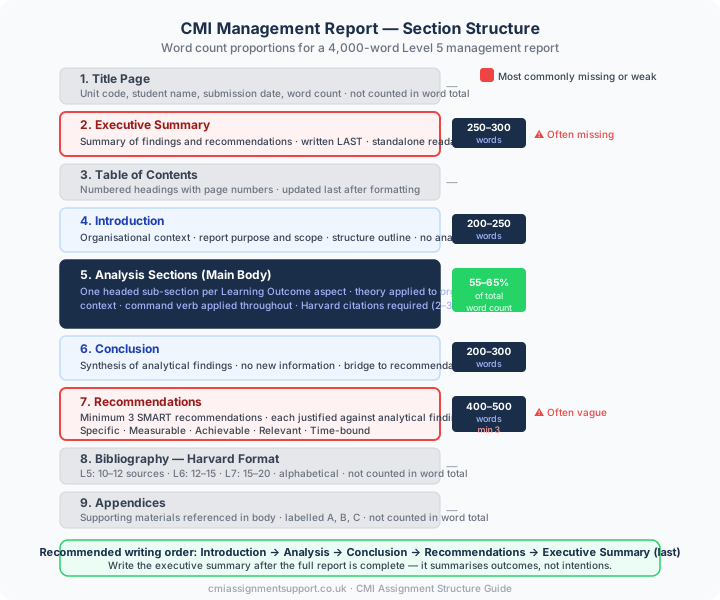
Title Page
The title page carries the unit code and title, the student’s name and registration number, the training provider’s name, the submission date, and the word count. It occupies its own page. It does not count toward the word count. The training provider may supply a template cover sheet, so always check before creating a title page independently.
Executive Summary: 250 to 300 Words, Written Last
The executive summary is the section most commonly missing from Level 5 student submissions. It is also one of the most commonly assessed sections, appearing as a named criterion in many Level 5, 6, and 7 unit frameworks.
The executive summary provides a standalone summary of the entire report: key findings from the analysis, the overall conclusion, and the top two to three recommendations. It should be written so that a reader who reads only this section can understand what the report found and what it recommends.
It is written last, after the full report is complete, even though it appears at the front. Students who write the executive summary before the main body produce an introduction with a different name. The executive summary summarises outcomes; it does not set up the argument.
The executive summary does not repeat the introduction, does not provide background context, and does not include detailed argument. It summarises the conclusions and recommendations that the report’s analysis has produced.
Table of Contents
A numbered list of headings with corresponding page numbers, generated after the document is finalised. Required for any management report over 3,000 words. Some training providers require it for all formal submissions. Update the table of contents last, after all content is written and formatted.
Introduction: 200 to 250 Words
The introduction establishes the context of the report: what organisation it relates to, what management challenge or topic the report addresses, and how the report is structured. It is brief and purpose-driven.
The introduction does not summarise findings; that is the executive summary’s role. It does not contain analysis or recommendations. It signals what the report will address and how it approaches it.
A typical introduction structure: one to two sentences establishing the organisational context, one sentence stating the report’s purpose and scope, one sentence outlining the report’s structure. Students who write long introductions that begin to analyse the topic dilute both the introduction and the first analysis section.
Main Body: Analysis Sections, 55 to 65 Percent of Total Word Count
The analysis sections are the largest part of the report and carry the highest mark weighting. For a 4,000-word report, the analysis sections total approximately 2,200 to 2,600 words. They are divided into headed sub-sections, with one sub-section per aspect of the Learning Outcome.
Each analysis section applies the command verb to a specific component. For a unit requiring Evaluate, each sub-section evaluates one management theory, approach, or factor against named criteria with supporting evidence. Description of what a theory says belongs in the introduction to the section, not in the main body. The bulk of each section must be application and evaluation.
Theory must be applied to the organisational context the assignment specifies. Explaining Kotter’s 8-Step Model without connecting its stages to the specific change scenario the assignment addresses produces a description, not an analysis. The test for each section is simple: if the section could appear unchanged in a different student’s assignment about a different organisation, it has not been applied. It has been described.
Evidence requirements: a minimum of two to three academic or professional sources per major analysis section, cited in Harvard format throughout. Sources should include management journals, textbooks, CMI publications, and professional body research. Each claim that is not self-evident or derived from the organisational context requires a citation.
Conclusion: 200 to 300 Words
The conclusion draws together the key findings from the analysis sections. It synthesises what the analysis has revealed and leads to the recommendations that follow. No new information appears in the conclusion: no new citations and no new arguments.
The conclusion is not a summary of section headings. It does not list what the report covered. It states what the analysis found and what that finding implies for the recommendations. A conclusion that begins “In conclusion, this report has discussed…” and then lists topics is a weak conclusion. A conclusion that begins “The analysis demonstrates that the organisation’s current approach to performance management produces consistent results in task completion but significant gaps in capability development, requiring the following priority actions…” is functional and appropriately connected to the recommendations that follow.
Recommendations: 400 to 500 Words, Minimum Three Recommendations
The recommendations section proposes specific, actionable steps the organisation should take based on the conclusions reached. It is the forward-looking output of the analysis and is assessed as a distinct criterion at Level 5 and above.
Each recommendation must be specific enough to action without further clarification. “The organisation should improve its approach to performance management” is a direction, not a recommendation. “The organisation should implement quarterly structured one-to-one performance conversations for all team members, with a standardised conversation framework developed by Q2, piloted across the operations division in Q3, and monitored against retention and engagement metrics” is a recommendation.
SMART framing is the standard: Specific (named action), Measurable (defined success metric), Achievable (realistic given resources), Relevant (connected to the analysis findings), and Time-bound (with a named timeline or milestone).
A minimum of three recommendations is the typical standard at Level 5. Each recommendation should include a brief justification: one to two sentences connecting it to the analytical findings in the main body.
Recommendations that introduce new arguments or evidence not present in the main body indicate a structural misunderstanding. The recommendations follow from the analysis; they do not supplement it.
Bibliography: Harvard Format
The bibliography lists all sources cited in the report in alphabetical order by author surname. Every in-text citation must have a corresponding bibliography entry. Sources that appear in the bibliography but are not cited in the text should not be included.
Harvard bibliography format: Author Surname, Initial. (Year). Title of work in italics. Edition if applicable. Place of publication: Publisher.
Source minimums by level: Level 5 requires a minimum of 10 to 12 sources; Level 6, 12 to 15 sources; and Level 7, 15 to 20 sources. Quality matters alongside quantity. Peer-reviewed management journals, established management textbooks, CMI publications, ManagementDirect, CIPD, ACAS, and UK government publications are appropriate sources. Wikipedia and general business news articles are not appropriate as primary academic sources.
The bibliography does not count toward the word count. Students sometimes underprioritise it, but incomplete or incorrectly formatted referencing costs marks on a specific assessment criterion at every level.
Appendices
Appendices contain supplementary materials that support the report without being part of the main argument, such as organisational charts, survey data, financial tables, SWOT or PESTLE matrices, and frameworks applied. Each appendix is labelled (Appendix A, Appendix B) and referenced in the main body where relevant (“see Appendix B for the full risk register”).
Appendices do not count toward the word count. They are not formally assessed as part of the main submission because the assessor marks the main body. Students who place key analytical content in appendices to manage word count are making a structural error: that content may not be credited.
CMI Essay Structure: Section by Section
A CMI essay uses an academic argument structure. It is the primary format at Levels 3 and 4, and remains relevant at Level 5 for units where command verbs such as Discuss or Analyse apply to theory-focused topics. Its structure differs from the management report in both purpose and section composition.
For help identifying whether your unit requires an essay or a management report, see our CMI essay writing help page.
Introduction: 200 to 250 Words
The introduction defines the key terms used in the essay question, states the essay’s argument direction or scope, and outlines the structure briefly. It signals what the essay will argue; it does not make the argument.
Defining key terms is not optional. A Level 3 essay on “the impact of leadership styles on team motivation” should define leadership style and team motivation in the first paragraph, citing established management theory for each definition. This demonstrates that the student is working from a specific theoretical understanding, not from a common-sense reading of the terms.
The introduction does not contain evidence or analysis. Any sentence that includes cited evidence belongs in the body, not the introduction. If the introduction starts to make analytical claims, the body paragraphs that follow will either repeat or extend them. Both options weaken the essay’s structure.
Body Paragraphs: PEEL Structure, 70 to 75 Percent of Total Word Count
Each body paragraph develops one analytical point using the PEEL framework: Point (state the argument or claim for this paragraph), Evidence (cite a supporting theory, study, or data source), Explanation (explain why the evidence supports the point and what it reveals about the essay topic), Link (connect the paragraph to the essay question or signal the next argument).
A 2,500-word essay typically contains four to six body paragraphs of 250 to 350 words each. Each paragraph makes one claim and supports it fully before moving to the next. Students who combine multiple arguments in a single paragraph produce writing that is difficult for an assessor to follow and harder to mark against specific criteria.
Command verb compliance is applied at the paragraph level, not just at the conclusion level:
Discuss paragraphs present one perspective with evidence, then engage with an alternative perspective within or between paragraphs. A Discuss essay that argues only one side, even with strong evidence, does not meet the command verb.
Analyse paragraphs decompose the subject of the paragraph into components and explain the relationships between them. Each paragraph should contain the word “because”, or equivalent relational language, multiple times.
Critically Analyse paragraphs include all elements of Analyse plus explicit statements about the limitations of the framework being applied and at least one reference to an alternative interpretation.
Conclusion: 200 to 250 Words
The conclusion synthesises the essay’s key arguments and reaches a final position. It does not introduce new information and does not cite new sources. It draws together what the body paragraphs have established and states what the weight of evidence supports.
A synthesis conclusion takes a position: “The evidence reviewed demonstrates that transformational leadership produces stronger motivational outcomes in knowledge-work contexts than transactional approaches, though this advantage is conditional on the leader’s sustained availability for individual-level communication, a constraint that limits its applicability in high-volume operational management roles.”
A summary conclusion lists what the essay covered: “In conclusion, this essay has discussed transactional and transformational leadership, motivation theories, and the implications for management practice.” The summary is weaker because it restates topics rather than synthesising findings. Assessors at Level 4 and above mark the synthesis, the statement of what the evidence demonstrates, not the restatement of content covered.
Bibliography: Harvard Format in CMI Essays
Harvard referencing applies in CMI essays at all levels. Minimum source requirements: Level 3 uses six to eight sources; Level 4, eight to ten sources; and Level 5, ten to twelve sources. All in-text citations must appear in the bibliography. The bibliography follows the same format as the management report bibliography: alphabetical by author surname, full publication details, italicised title.
CMI Reflective Account Structure: Gibbs’ Reflective Cycle
A CMI reflective account is structured around a recognised reflective model. Gibbs’ Reflective Cycle (1988) is the most widely used framework for CMI reflective accounts and is explicitly referenced in units such as CMI 525 (Using Reflective Practice to Inform Personal and Professional Development). Kolb’s Experiential Learning Cycle is an alternative used in some training provider contexts.
Free-form personal narrative, writing about what happened and what you think about it without a structured reflective framework, does not meet the assessment criteria for reflective units. The framework is the structure. Each stage of the cycle maps to a section of the assignment.
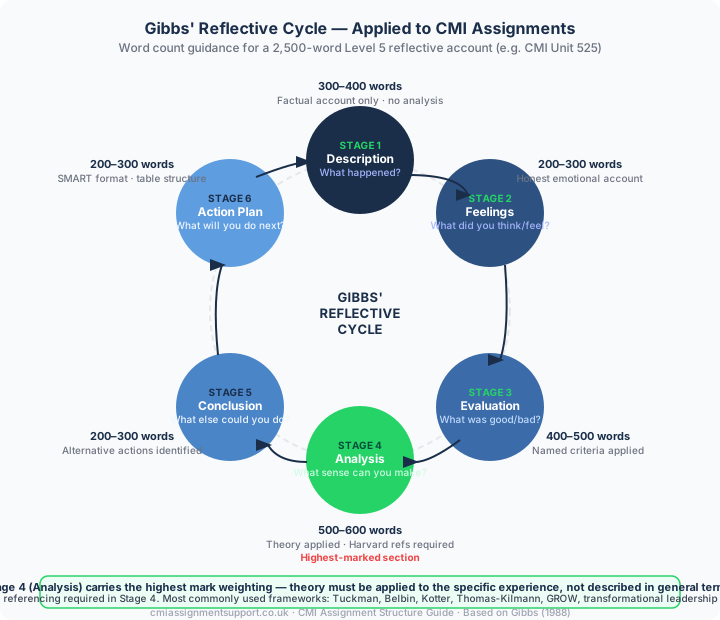
Stage 1: Description, 300 to 400 Words
A factual account of the specific experience, event, or situation being reflected upon. What happened, who was involved, where and when it occurred, and what the immediate outcome was. First-person voice, past tense. No analysis, interpretation, or evaluation at this stage; description only.
Students who begin analysing in Stage 1 disrupt the structure of the reflective cycle and produce thinner analysis in Stage 4, where the academic depth is required. The description is the raw material. The analysis comes later.
The experience should be specific. “A management situation I encountered” is not specific enough. “A conflict between two team members during a project planning meeting in October 2023, which required me to intervene as their line manager” is specific and provides the concrete material that later stages will analyse.
Stage 2: Feelings, 200 to 300 Words
An honest account of the student’s thoughts and feelings at the time of the experience and immediately afterwards. What did you think was happening- How did you feel: confident, uncertain, frustrated, or out of your depth- What was your first response-
Many working managers are uncomfortable with this stage. A professional reflective account includes emotional acknowledgement because CMI explicitly assesses self-awareness as a management and leadership competency at Levels 5 and above. A sanitised feelings section that reports only professional composure raises questions about the depth of self-reflection. Honesty here strengthens the analysis that follows.
Stage 2 does not evaluate or judge; it reports. “I felt underprepared because I had not anticipated the level of conflict” is a feelings statement. “I should have anticipated the conflict and prepared differently” is evaluation, which belongs in Stage 3.
Stage 3: Evaluation, 400 to 500 Words
A value judgement about the experience: what went well, what did not, and why. This is where criteria are applied, including professional standards, organisational expectations, and personal development goals. The question being answered is: against what standard do I judge this experience, and how did it measure up-
Stage 3 is evaluation in the CMI command verb sense. It applies criteria and reaches a judgement. Students who describe what went well and what went badly without naming the criteria they are using against have produced description with value labels, not evaluation.
A strong Stage 3 names the standard: “Against the expectation that a manager should de-escalate interpersonal conflict before it becomes visible to the broader team, my intervention was delayed. I was aware of the tension for two days before acting. This delay allowed the conflict to affect the wider team’s focus during the planning meeting.”
Stage 4: Analysis, 500 to 600 Words
The analytical stage applies management theory to explain why the experience unfolded as it did. This is where academic sources are cited and the response earns its academic credentials. Stage 4 is the highest-marked section in reflective accounts at Level 5 and above.
The theory must be applied to the specific experience, not described in general terms. Describing Thomas and Kilmann’s conflict management model in Stage 4 does not meet the standard. Applying Thomas and Kilmann’s model to the specific conflict, identifying which conflict-handling mode was used, why, and whether it was appropriate to the situation given the model’s guidance, is the required application.
Management theories relevant to reflective accounts include: leadership models (transformational, situational, servant leadership), team dynamics (Tuckman’s stages, Belbin’s team roles), motivation theories (Maslow, Herzberg, Vroom), communication frameworks, change management models (Kotter, Lewin), and coaching models (GROW). The choice of theory must be appropriate to the experience being analysed.
Harvard referencing is required throughout Stage 4. Academic sources cited in this section carry the same referencing requirements as in a management report or essay.
Stage 5: Conclusion, 200 to 300 Words
A reflection on what else could have been done, what alternative approaches were available, and why they might have produced a better outcome. This is not a summary of the assignment. It answers: given what I now understand from the analysis, what would I have done differently and why-
Stage 5 draws directly on the analysis in Stage 4. If the analysis concluded that the conflict management approach used was suboptimal according to Thomas and Kilmann’s model, Stage 5 identifies what alternative approach the model would have recommended and why that approach would have been more effective in this specific situation.
Students who write a final summary in Stage 5 indicate that they have misread its purpose. Stage 5 is not a conclusion to the essay. It is a conclusion to the reflective cycle, focused specifically on alternative action.
Stage 6: Action Plan, 200 to 300 Words Plus Table
The action plan converts the reflection into professional development commitment. What specific development actions will the student take to build the capability or address the gap identified through the reflection- The action plan is structured in SMART format and is often presented as a table.
A typical action plan table uses these columns: Development Need, Planned Action, Timeline, Resource Required, Success Measure.
Example row: Development Need: conflict de-escalation skills; Planned Action: complete the CMI-recommended conflict management module on ManagementDirect and apply one technique from Thomas and Kilmann in the next team conflict situation; Timeline: within three months; Resource: ManagementDirect access, line manager feedback session; Success Measure: reduction in escalation time in next conflict situation, evidenced by self-assessment and 360 feedback.
A vague action plan such as “I will work on my conflict management skills going forward” signals that the reflection has been treated as an academic exercise rather than a genuine professional development process. CMI assessors identify this and it affects the grade for the reflective unit as a whole.
Harvard Referencing in CMI Assignments
Harvard referencing is required in every CMI assignment format without exception. Management reports, essays, and reflective accounts all require in-text citations and a full bibliography.
In-text citation format: (Author Surname, Year), for example, (Kotter, 1995).
Direct quotation format: (Author Surname, Year, p. page number), for example, (Kotter, 1995, p. 47).
Bibliography entry format: Author Surname, Initial. (Year). Title of Work. Edition if applicable. Place of publication: Publisher.
Source minimums: Level 3, six or more; Level 4, eight to ten; Level 5, ten to twelve; Level 6, twelve to fifteen; Level 7, fifteen to twenty.
Accepted source types: Peer-reviewed management journals, established management and leadership textbooks, CMI publications and ManagementDirect, CIPD research, ACAS guidance, UK government and NHS publications, professional body reports. Wikipedia and unattributed web articles are not acceptable as academic sources at any level.
Every in-text citation must have a corresponding bibliography entry. Every bibliography entry must be cited in the text. References that appear in only one location indicate incomplete referencing and cost marks on a specific criterion. See our CMI assignment writing service if you need full Harvard referencing included as part of your completed assignment.
Common CMI Assignment Structural Errors That Cause Resubmissions
The structural errors that cause CMI resubmissions are consistent across levels. These are the six most common.
Missing executive summary in a management report. The executive summary is an assessed section at Level 5 and above. Its absence leaves a specific criterion unmarked. It is written after the main report is complete. Students who write it before the body produce an extended introduction rather than a summary of findings. Write the executive summary last.
Vague recommendations with no SMART framing. Recommendations that state a direction (“improve communication”) rather than a specific action (“implement weekly structured team briefings with a defined agenda, from Q2”) are assessed at pass level regardless of the quality of the analysis that precedes them. Every recommendation must be specific, timed, and connected to the analysis findings.
Descriptive analysis sections. Analysis sections that explain what a management theory says without applying it to the organisational context specified in the task produce description, not analysis. The theory is the tool, and the organisational situation is what the tool is applied to. If an analysis section could appear unchanged in a different student’s assignment, it has not been applied.
Conclusions that introduce new evidence. A conclusion that cites a new source or makes an argument not established in the main body indicates that the analysis is incomplete. New information in a conclusion dilutes the synthesis and suggests the writer ran out of space in the main body. Write the conclusion from what the analysis has already demonstrated.
Key analytical content placed in appendices. Appendices contain supporting material; they are not an extension of the main body. Analytical content placed in appendices is unlikely to be credited by the assessor because the marking standard applies to the main body. If analysis is important enough to include, it belongs in a headed section of the main report.
Absent or informal Harvard referencing. Missing in-text citations, bibliography entries that do not match citations, and incorrect formatting cost marks on a dedicated referencing criterion at every level. Harvard referencing is not optional and is not informal. Every claim based on external knowledge requires a citation.
If you are unsure whether your assignment structure meets CMI assessment criteria, send your draft to us on WhatsApp before submission. We will identify structural gaps and advise on what needs to be added or restructured.
Send your draft on WhatsApp: structure review before submission.
CMI Assignment Structure by Level
The same format types are used across levels, but the expectations applied to each section intensify as the level increases. The table below shows what changes structurally at each level.
| CMI Level | Primary Format | Executive Summary Required | Recommendations Expected | Source Minimum | Key Structural Differentiator |
|---|---|---|---|---|---|
| Level 3 | Essay or structured answer | No | No | 6+ | PEEL paragraph structure; introduction defines key terms |
| Level 4 | Essay; some short management reports | Some providers require it | Sometimes | 8 to 10 | Analyse depth in paragraphs; begins to transition toward report format |
| Level 5 | Management report | Yes, assessed criterion | Yes, SMART, minimum 3 | 10 to 12 | Executive summary and SMART recommendations are formally assessed |
| Level 6 | Extended management report | Yes, assessed criterion | Yes, SMART and justified | 12 to 15 | Critically Evaluate depth required; longer analysis sections; more sources |
| Level 7 | Strategic management report or extended analysis | Yes | Yes, strategic level with risk analysis | 15 to 20 | Strategic scope (organisational, sector, or systems level); critically evaluative throughout |
For level-specific guidance on assignment requirements, see:
- CMI Level 3 assignment help
- CMI Level 4 assignment help
- CMI Level 5 assignment help
- CMI Level 6 assignment help
- CMI Level 7 assignment help
FAQ: CMI Assignment Structure
Does a CMI assignment need an executive summary Management reports at Level 5 and above typically require an executive summary as an assessed section. Check your unit’s Assessment Criteria or ask your training provider whether it is explicitly marked. Essays and reflective accounts do not use an executive summary. If your training provider specifies that it is required, include it. If in doubt, including one will not count against you.
How many words should each section of a CMI management report be For a 4,000-word management report: Executive Summary (250 to 300 words), Introduction (200 to 250 words), Analysis sections (2,200 to 2,600 words across all headed sub-sections), Conclusion (200 to 300 words), Recommendations (400 to 500 words). These are proportional guidelines. Always follow your unit brief’s specific word count allocation if your training provider provides one.
Can I use bullet points in a CMI assignment In management reports, bullet points are appropriate in the recommendations section and in appendices. In the analysis sections, continuous prose is expected because bullet-pointed analysis does not demonstrate the reasoning depth that Evaluate and Justify require. In essays, avoid bullet points throughout the body. In reflective accounts, the action plan table uses a structured format rather than prose narrative.
What is the difference between the conclusion and the recommendations in a management report The conclusion synthesises what the analysis found and reaches a judgement based on the evidence presented. The recommendations propose specific actions the organisation should take based on those conclusions. They are separate sections with different functions. A conclusion that lists recommendations, or recommendations that include new analysis, indicates a structural misunderstanding that costs marks in both sections.
Do CMI assignments need a title page and table of contents Most training providers require a title page for all submissions. A table of contents is required for management reports and recommended for any report over 3,000 words. Check your training provider’s submission template before creating either, as some providers supply a mandatory cover sheet.
How many sources does a CMI assignment need Source requirements scale with level. Level 3 essays need a minimum of six sources; Level 5 management reports need ten to twelve; Level 7 strategic reports need fifteen to twenty. Source quality matters alongside quantity, and peer-reviewed management journals and established management textbooks are preferred. Every source cited must appear in the bibliography and every bibliography entry must be cited in the text.
CMI Assignment Structure Guide: section-by-section format guidance for management reports, essays, and reflective accounts at all CMI levels. For structure review or full assignment help, WhatsApp us with your unit brief.