CMI Level 5 vs Level 7 — Five Key Differences Explained
CMI Level 5 and Level 7 are the two most studied and most compared CMI qualification levels. Level 5 is the Management and Leadership Diploma — the most widely pursued CMI credential for practising managers. Level 7 is the Strategic Management and Leadership Diploma — the highest CMI qualification, equivalent to a Master’s degree. Students considering both often ask the same question: which one is right for me, and what exactly is different about each?
The answer is not simply that Level 7 is longer or harder in the same way. Level 5 and Level 7 are qualitatively different academic undertakings — different in scope, format, command verb depth, academic standard, and the professional perspective they require. This page explains those differences precisely so you can make an informed decision — and so you know what assignment support you will need if you study either level.
CMI LEVEL 5 VS LEVEL 7 COMPARISON TABLE — Place below intro paragraph, above first H2
Alt text: CMI LEVEL 5 VS LEVEL 7 COMPARISON TABLE — Place below intro paragraph, above first H2
The Five Key Differences Between CMI Level 5 and Level 7
1 — Scope: Operational vs Strategic
CMI Level 5 operates at the level of the team, department, or operational function. A Level 5 assignment might ask you to evaluate a performance management approach for your team, develop a stakeholder communication strategy for a departmental change, or analyse the leadership style most effective for your management context. The frame of reference is the manager and their immediate operational responsibility.
CMI Level 7 operates at the level of the organisation, the sector, or the board. A Level 7 assignment asks you to critically analyse strategic leadership models across an organisation, evaluate corporate strategy development against competitive frameworks, or develop a board-level risk management governance structure. The frame of reference is the executive and their responsibility for the organisation’s strategic direction.
This is not a difference of complexity alone — it is a difference in perspective. Level 5 asks “how does a manager handle this?” Level 7 asks “how does an organisation design, lead, and govern this?” A Level 7 student who approaches their assignment from an operational manager’s perspective consistently produces work that misses the strategic scope assessors require.
2 — Assignment Format: Management Report vs Strategic Paper
CMI Level 5 primarily uses the management report format: title page, executive summary (250–300 words, written last), contents page, analysis sections mapped to Assessment Criteria, conclusion, SMART recommendations, and Harvard bibliography. Most Level 5 units — 501, 502, 504, 509 — use this format.
CMI Level 7 uses a strategic paper format: strategic analysis, critically evaluated strategic options, governance implications, and strategic recommendations with organisational alignment considerations. It differs from the management report in scope (organisation-wide), register (strategic rather than operational), and the nature of recommendations (strategic options with governance and resource implications, not SMART operational actions).
Students who submit a Level 7 strategic paper formatted as an extended Level 5 management report — SMART recommendations, operational-level analysis, no strategic scope — produce work that is structurally misaligned with the Assessment Criteria.
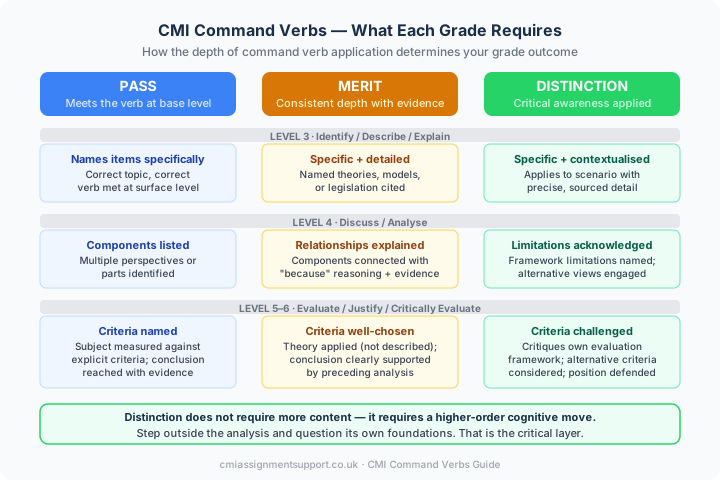
3 — Command Verbs: Evaluate vs Critically Analyse
This is the most academically significant difference between Level 5 and Level 7.
At CMI Level 5, the primary command verb is Evaluate — and at Level 6, Critically Evaluate. Evaluate requires establishing criteria, applying evidence, and reaching a reasoned judgement.
At CMI Level 7, the defining command verb is Critically Analyse. This requires a qualitatively different mode of engagement:
- Decompose the strategic concept or problem into its constituent components
- Apply empirical evidence — not management textbooks, but peer-reviewed research and empirical case studies
- Identify the assumptions embedded in the frameworks being applied and examine their validity
- Engage with conflicting theoretical perspectives — where researchers disagree, the Level 7 student takes a position and defends it
- Synthesise an original strategic position — a view that goes beyond summarising existing literature
In practice: a Level 5 assignment might Evaluate transformational leadership using Bass and Avolio’s model, applying criteria of team motivation effectiveness and practical managerial applicability. A Level 7 assignment Critically Analyses transformational leadership — examining its conceptual foundations, the empirical evidence base across multiple sectors, critiques questioning its universal validity, cultural limitations of the research base, and a synthesised strategic position on where and under what conditions transformational leadership creates genuine organisational competitive advantage.
The Level 7 distinction is not more content — it is a fundamentally different mode of academic engagement.
4 — Academic Sources: Management Texts vs Peer-Reviewed Research
CMI Level 5 requires 10–12 sources per assignment. Appropriate sources include management textbooks, CMI publications, ManagementDirect, and government or industry reports.
CMI Level 7 requires 15–20 sources per assignment, with a strong emphasis on peer-reviewed academic research, empirical studies, and strategic frameworks from the research literature. Management textbooks are insufficient at Level 7 — assessors expect engagement with the research evidence behind the theories, including studies that challenge or qualify them.
The source quality expectation at Level 7 reflects the qualification’s Master’s equivalence. A Level 7 student who cites only textbooks and ManagementDirect is producing work at the Level 5 academic standard, regardless of the strategic framing of their argument.
5 — Word Count and Total Qualification Commitment
CMI Level 5 assignments are typically 3,000–5,000 words per unit. A full Level 5 Diploma involves 6–8 units, producing approximately 18,000–30,000 words alongside full-time management work.
CMI Level 7 assignments are typically 5,000–6,500 words per unit, extending to 8,000–12,000 words for the CMI 712 and 713 research units. A full Level 7 Diploma involves 6–8+ units, producing 35,000–50,000 words — comparable to a Master’s dissertation in volume.
The per-unit word count at Level 7 is not simply longer — it is denser. The Critically Analyse requirement, 15–20 sources per unit, and the strategic scope demand mean that every word needs to carry more analytical weight than a Level 5 management report.
Which CMI Level Is Right for You?
STUDENT PROFILE CARDS — Place below this heading, above the decision guide table
Alt text: STUDENT PROFILE CARDS — Place below this heading, above the decision guide table
| If you are… | Consider… |
|---|---|
| A team leader, operational manager, or department head managing a team and responsible for operational delivery | CMI Level 5 — Management and Leadership Diploma is designed for your management level and context |
| An NHS manager at Band 7 or below, a project manager, or a middle manager stepping into a broader leadership role | CMI Level 5 — the most widely studied CMI level for operational management professionals |
| A director, VP, C-suite executive, NHS Band 8b+ leader, or senior partner with strategic, organisational-level accountability | CMI Level 7 — Strategic Management and Leadership Diploma reflects the scope of your role |
| A senior manager moving from operational to strategic responsibility — recently promoted or targeting a director role | CMI Level 6 — Professional Management and Leadership bridges the gap; see CMI Level 6 assignment help |
| Unsure whether you qualify for Level 7 | The entry requirement is professional experience and employer sponsor decision — not a prior CMI qualification. If you lead at an organisational or strategic level, Level 7 is the appropriate credential regardless of prior academic history |
The most common decision error is choosing Level 5 when Level 7 is appropriate for the student’s role — often because Level 7 looks more demanding. For a director or senior executive, a Level 5 qualification understates their management scope and produces assignments that feel misaligned with their actual professional context.
Can You Go Straight to CMI Level 7 Without Doing Level 5?
Yes. CMI qualification levels are not sequential prerequisites. Entry to Level 7 is based on your professional experience and your employer or training provider’s assessment of your readiness — not on prior CMI qualification. Many Level 7 students have never studied at Level 5.
What you need for Level 7:
- A senior leadership role with strategic or organisational-level accountability
- Employer sponsorship or self-funded commitment to the qualification
- Readiness for postgraduate-level academic writing — Critically Analyse depth, 15–20 sources per unit, strategic scope throughout
What you do not need:
- A prior CMI qualification at Level 5 or Level 6
- A degree (though prior academic experience helps with the research and referencing standard)
Where Does CMI Level 6 Fit?
CMI Level 6 — Professional Management and Leadership — sits between Level 5 and Level 7 and is studied less frequently than either. It uses Critically Evaluate as its primary command verb — above Level 5’s Evaluate and below Level 7’s Critically Analyse.
Level 6 is appropriate for senior managers who are responsible for cross-functional or complex organisational programmes but who are not operating at director or board level. For students deciding between Level 5 and Level 7, Level 6 is rarely the answer — most students and employers are looking for either the practitioner-level credential (Level 5) or the strategic executive credential (Level 7).
For specialist support, see CMI Level 6 assignment help.
CMI Membership Outcomes — Level 5 vs Level 7
| Level | Diploma Completion | CMI Membership Grade |
|---|---|---|
| Level 5 | Diploma in Management and Leadership | Supports application for ACMI (Associate Member of CMI) |
| Level 6 | Diploma in Professional Management and Leadership | Supports application for MCMI (Member of CMI) |
| Level 7 | Diploma in Strategic Management and Leadership | Supports application for FCMI (Fellow of CMI) — the most prestigious CMI grade |
FCMI is the senior professional recognition for strategic leaders who have demonstrated sustained contribution at the highest management level. CMI membership grades are applied for separately from qualification completion — completing the Diploma supports the application but does not automatically confer membership.
Assignment Help for Both Levels
Whether you are studying Level 5 or Level 7, the quality of the assignment support you use must match the level you are studying at.
CMI Level 5 assignment help — all 25 units of the Management and Leadership Diploma, management report format, Evaluate depth. UK writers with Level 5 management experience.
CMI Level 7 assignment help — all 17 units of the Strategic Management and Leadership Diploma, strategic paper format, Critically Analytical depth. Senior UK writers with director-level experience and CMI Level 7 or MBA qualifications.
CMI assignment writing service — full assignment writing at any level.
WhatsApp us to discuss your level, unit, and what you need — free quote, immediate response.
FAQ — CMI Level 5 vs Level 7
What is the difference between CMI Level 5 and Level 7? Five key differences: scope (operational/team vs strategic/organisational), format (management report vs strategic paper), command verbs (Evaluate vs Critically Analyse), academic sources (10–12 management texts vs 15–20 peer-reviewed journals), and word count (3,000–5,000 per unit vs 5,000–6,500 per unit). Level 7 is not Level 5 at a higher word count — it is a qualitatively different academic undertaking.
Which is harder — CMI Level 5 or Level 7? Level 7 is harder in a qualitative sense, not just a quantitative one. The Critically Analyse command verb requires a different mode of academic engagement — decomposing strategic concepts, applying empirical research, engaging with competing theoretical perspectives, and synthesising an original strategic position. Level 5’s Evaluate requires criteria and evidence; Level 7’s Critically Analyse requires all of that plus theoretical limitation analysis and an original defended synthesis.
Can I go straight to CMI Level 7 without doing Level 5? Yes. Entry to Level 7 is based on professional experience and employer or training provider decision — not on prior CMI qualification. Many Level 7 students have not studied at Level 5. The entry requirement is a senior leadership role with strategic or organisational-level accountability, not a prerequisite qualification.
How long does CMI Level 5 take compared to Level 7? The Level 5 Diploma typically takes 12–24 months studying alongside full-time work. The Level 7 Diploma typically takes 18–36 months — reflecting the higher per-unit word count, the more demanding academic standard, and the additional research requirements.
What CMI membership do I get from Level 5 vs Level 7? Completing the Level 5 Diploma supports application for ACMI (Associate Member of CMI). Completing the Level 7 Diploma supports application for FCMI (Fellow of CMI) — the most prestigious CMI membership grade. Level 6 supports MCMI (Member of CMI).
What is CMI Level 6 and where does it fit between Level 5 and Level 7? CMI Level 6 — Professional Management and Leadership — sits between Level 5 and Level 7. Its primary command verb is Critically Evaluate — more demanding than Level 5’s Evaluate but below Level 7’s Critically Analyse. Level 6 is appropriate for senior managers operating above operational management but below strategic/director level.
CMI Level 5 vs Level 7 — scope, format, command verbs, and academic standard compared. Expert assignment help available for both levels from UK-based CMI-qualified writers. WhatsApp for a free quote.