CMI 705 Assignment Help â Leading Strategic Change
CMI Unit 705 â Leading Strategic Change is the fourth most-requested Level 7 unit and one of the most practically urgent for senior leaders. Strategic change â full organisational transformations, digital overhauls, structural redesigns, post-merger integration, culture change at scale â is among the most demanding leadership challenges at board and executive level. CMI 705 requires the student to critically analyse the theoretical frameworks through which strategic change is understood and led, examine the strategic leader’s specific role in managing resistance and building change capability, and evaluate approaches to sustaining change and building the organisational resilience that makes future change possible. Assignments are submitted as strategic papers of 5,000â6,000 words at Critically Analyse depth, with 15â20 peer-reviewed sources.
The critical distinction students must establish from the outset: CMI 705 is not CMI Level 5 Unit 512 at a higher word count. Unit 512 â Principles of Change Management â applies Kotter’s 8-Step Model and Lewin’s Force Field Analysis to an organisational or departmental change at Evaluate depth. CMI 705 Critically Analyses strategic change leadership at the scale of full organisational transformation â board-level governance of change, complexity theory challenges to planned change models, multi-year programme leadership, and building the organisational resilience that enables adaptive response to continuous change. The scope, command verb, source standard, and analytical depth are categorically different.
Every CMI 705 assignment we deliver is written by a senior writer with direct experience leading or governing organisational-scale change â NHS transformation programmes, public sector restructuring, commercial change at executive level â where the gap between change theory and change practice is well understood.
UNIT INFO BADGE ROW â Place below H1 intro, above first H2
Alt text: UNIT INFO BADGE ROW â Place below H1 intro, above first H2
Get CMI 705 Assignment Help on WhatsApp â Senior Strategic Writers
Send your unit brief, assignment question, and deadline for an immediate response.
What Is CMI Unit 705 and What Does It Cover?
CMI Unit 705 â Leading Strategic Change addresses one of the defining challenges of strategic leadership: the ability to design, lead, govern, and sustain organisational change at the scale of full transformation. It is not about managing a team through a process change or leading a departmental restructure â these are the Level 5 concerns of Unit 512. CMI 705 examines how strategic leaders lead change across entire organisations, across multi-stakeholder environments, over multi-year timeframes, and against the persistent forces of organisational resistance, complexity, and institutional inertia.
The unit is assessed against three Assessment Criteria:
- AC1 â Critically analyse theoretical frameworks for leading strategic change
- AC2 â Critically analyse the strategic leader’s role in managing organisational resistance and building change capability
- AC3 â Evaluate approaches to sustaining strategic change and building organisational resilience
AC1 requires Critical Analysis of the major change leadership frameworks â Kotter, Lewin, ADKAR, and the complexity theory challenge to all planned change models. AC2 examines what the strategic leader specifically does to address resistance at organisational scale and build the capability for sustained change. AC3 evaluates how change is sustained beyond the initial implementation phase and how the organisation builds the resilience to absorb and respond to continuous change.
CMI 705 Assessment Criteria â What the Assessor Is Marking
AC1 â Critically analyse theoretical frameworks for leading strategic change
The assessor expects engagement with the empirical evidence base and the theoretical limitations of each major change framework â not application of Kotter’s 8 steps or Lewin’s freeze model to a change scenario. Which steps in Kotter’s model have the strongest empirical support? Where does the model fail in complex, multi-stakeholder organisations? What does complexity theory say about the fundamental assumptions all planned change models share? These are the analytical questions AC1 requires.
AC2 â Critically analyse the strategic leader’s role in managing resistance and building change capability
Resistance to change is not a people problem to be managed away â it is a systemic, political, and cultural phenomenon with multiple causes. At strategic scale, resistance manifests through institutional inertia, vested interests, structural power dynamics, and the legitimate concerns of stakeholders whose position the change threatens. AC2 requires Critical Analysis of how the strategic leader understands and addresses resistance at this level â not communication plans and stakeholder engagement templates, but the structural, cultural, and political dimensions of resistance in complex organisations.
AC3 â Evaluate approaches to sustaining strategic change and building organisational resilience
Note that AC3 uses Evaluate â not Critically Analyse. It requires a thorough evaluation of the conditions, governance structures, and leadership behaviours that make strategic change stick after the initial transformation, and that build the organisational capacity to absorb and adapt to future change. Organisational resilience is the emergent outcome â not a programme to implement but a capability to develop.
What CMI 705 Assignments Require â Format, Word Count, and Academic Standard
Word count: 5,000â6,000 words per your training provider’s specification.
Academic sources: 15â20 peer-reviewed sources, drawn from organisational change, strategic leadership, and complexity theory journals â Journal of Change Management, Organization Science, Academy of Management Review, Leadership Quarterly, Journal of Applied Behavioral Science. Kotter (1996) is a practitioner text that should be cited alongside the empirical research that tests his claims â not as the primary theoretical authority on change.
CMI 705 Strategic Paper â Section by Section
| Section | Purpose | CMI 705 Notes |
|---|---|---|
| Title Page | Unit details | Include “Unit 705 â Leading Strategic Change” |
| Executive Summary | Board-briefing standard summary | 300â400 words. Summarises key findings on change framework limitations, resistance management approach, and resilience recommendations. |
| Contents Page | Section headings | â |
| Introduction | Organisational context and strategic change scenario | 300â400 words. Define the organisation and the strategic change context â what is being changed, at what scale, over what timeframe. |
| AC1 Section | Critically analyse change frameworks | Kotter, Lewin, ADKAR â empirical evidence, limitations, complexity theory challenge |
| AC2 Section | Critically analyse resistance management and change capability | Systemic resistance, political dynamics, building change leadership capacity at scale |
| AC3 Section | Evaluate sustaining change and resilience | Conditions for embedding change, high reliability organisation principles, adaptive capacity |
| Conclusion | Strategic synthesis | 250â350 words â defended position on strategic change leadership approach |
| Strategic Recommendations | 2â3 board-level recommendations | Change governance, resilience investment, capability building |
| Bibliography | Harvard references | 15â20 peer-reviewed sources |
Key Frameworks in CMI Unit 705
Kotter’s 8-Step Change Model â Critical Analysis at Level 7
John Kotter’s (1996) 8-Step Change Model is the most widely cited change leadership framework in management practice. The eight steps â establish urgency, form a guiding coalition, develop a vision, communicate the vision, empower broad-based action, generate short-term wins, consolidate gains and produce more change, anchor new approaches in culture â provide a sequential framework for leading organisational change.
At Level 5, students Evaluate Kotter. At Level 7, students Critically Analyse it.
Empirical evidence base: Kotter’s model is widely applied but weakly evidenced. It is derived from Kotter’s observation of failed change programmes rather than from controlled empirical studies of successful ones. The “70% of change programmes fail” statistic Kotter cites has itself been challenged â Kotter (1995) cited it without primary data, and subsequent attempts to verify the figure have found no robust empirical basis (Hughes, 2011).
Step-level critical analysis:
Step 1 (Establish urgency): Creating urgency is presented as a prerequisite for change, but research on crisis and urgency in organisations suggests that artificial urgency â manufactured rather than genuine â produces anxiety rather than mobilisation and can damage the psychological safety conditions required for the learning and adaptation that complex change requires (Edmondson, 2018).
Steps 2â3 (Guiding coalition and vision): The model assumes that a small group of leaders can design and communicate a change vision that the broader organisation will adopt. Complexity theory (Stacey, 2001) challenges this assumption â in complex adaptive systems, change outcomes emerge from the interactions of many agents, not from the plans of a guiding coalition. Participative design approaches produce more durable change than top-down vision communication in organisations with high levels of professional expertise (NHS, education, professional services).
Step 8 (Anchor in culture): Culture change is presented as the final step â the outcome of successful change implementation. Schein’s (1985, 2010) culture model suggests the reverse: that culture is the most powerful enabler or constraint on change throughout the process, not a lever to be pulled at the end. Change programmes that do not address the underlying assumptions of the existing culture (Schein’s deepest level) rarely produce durable transformation.
KOTTER'S 8-STEP MODEL WITH CRITIQUE ANNOTATIONS â Place after Kotter section, before Lewin H3
Alt text: KOTTER'S 8-STEP MODEL WITH CRITIQUE ANNOTATIONS â Place after Kotter section, before Lewin H3
Lewin’s Force Field Analysis and Freeze Model
Kurt Lewin (1951) proposed two foundational contributions to change theory. Force Field Analysis views any situation as held in equilibrium by driving forces (pushing toward change) and restraining forces (resisting change). Change is achieved either by strengthening driving forces or weakening restraining forces â with the latter generally producing less resistance. The three-stage model â unfreezing (destabilising the existing equilibrium), changing (moving to the new state), and refreezing (stabilising the new equilibrium) â provides the conceptual basis for most planned change approaches.
Critical Analysis at Level 7:
Force Field Analysis retains significant practical utility at strategic scale â its core logic (identify what is driving and what is resisting change, intervene to shift the balance) is applicable at any organisational level. Its limitation is its assumption of identifiable, relatively stable forces that the leader can assess and act on sequentially. In complex, rapidly changing environments, the forces are themselves dynamic â new restraining forces emerge as driving forces are strengthened; removing one restraining force reveals others previously masked.
The refreezing concept has attracted the most sustained critique. Burnes (2004) and others argue that Lewin’s refreezing was always a misrepresentation of his intent â Lewin conceptualised organisational change as continuous and quasi-stationary rather than as a movement between stable states. In post-bureaucratic organisations operating in volatile environments, the refreezing metaphor is actively unhelpful â it implies a stability that rarely exists and cultivates change fatigue by repeatedly unfreezing and refreezing what should be continuous adaptation.
ADKAR â Individual Change at Organisational Scale
The ADKAR model (Prosci) addresses change at the individual level: Awareness (of the need for change), Desire (to support and participate), Knowledge (of how to change), Ability (to implement the change), and Reinforcement (to sustain the change). It is the most practitioner-oriented of the major change frameworks and the most widely used in organisational change management programmes.
Critical Analysis at Level 7:
ADKAR’s individual focus is both its strength and its fundamental limitation for strategic-scale change analysis. It provides a granular diagnostic tool for understanding why individuals in an organisation are not changing â which of the five building blocks is the primary barrier? This is genuinely useful at the implementation level, where change programme managers need to diagnose and address individual adoption barriers.
Its limitation at strategic scale is that it treats organisational change as the aggregate of individual changes, missing the systemic, structural, and political dimensions that determine whether change succeeds at organisational level. A change programme in which every individual achieves ADKAR alignment can still fail if the structural systems, incentive structures, and power dynamics of the organisation remain misaligned with the desired new state (Kotter and Cohen, 2002). The model also provides limited guidance on the sequencing and interdependency of individual changes across large, complex organisations.
Complexity Theory and the Challenge to Planned Change â Stacey
Ralph Stacey (1996, 2001) drew on complexity science to challenge the fundamental assumptions of planned change models. In complex adaptive systems â and Stacey argues that organisations are inherently complex adaptive systems â outcomes emerge from the non-linear interactions of many agents rather than from the implementation of designed plans. Strategic change, in this view, is not something leaders do to organisations â it is something that emerges from the organisation’s ongoing interactions, conversations, and political processes.
The challenge to Kotter, Lewin, and ADKAR: All three planned change models share a common assumption: that a small group of leaders can diagnose the current state, design a desired future state, and lead a transition between the two. Complexity theory challenges each element of this assumption. The current state of a complex system cannot be fully diagnosed from any single vantage point. The desired future state cannot be fully specified in advance â it will be shaped by the emergent dynamics of the change process itself. The transition cannot be managed as a linear sequence of steps â it will be characterised by non-linearity, unintended consequences, and emergence.
What Critically Analysing complexity theory adds to CMI 705 AC1: The most valuable contribution of complexity theory to strategic change leadership is not a prescription for how to lead change differently â Stacey himself resists this framing â but a challenge to the certainty and control that planned change models assume. A strategic leader who understands complexity theory approaches change with greater epistemic humility, invests more in sense-making and learning mechanisms, and resists the temptation to over-specify and over-control the change process. This connects directly to Edmondson’s psychological safety conditions (AC2) and Weick’s high reliability organisation principles (AC3).
Managing Resistance at Strategic Scale â AC2
Resistance to strategic change is not primarily a people problem. It is a systemic, political, and cultural phenomenon. At organisational scale, resistance manifests through:
Institutional inertia: The structural systems, processes, incentive structures, and role designs that were optimised for the current state create momentum against change. People are not resisting the change because they prefer the old way â they are behaving rationally within a system that has not yet been redesigned to support the new way.
Vested interests and political dynamics: Strategic change produces winners and losers â those whose power, resources, and influence increase under the new structure, and those whose position is diminished. Political resistance from those who lose power is rational, not irrational, and cannot be addressed through communication or urgency-creation alone. It requires structural changes to the power distribution, which is the most politically sensitive dimension of any strategic transformation.
Legitimate concerns: Not all resistance to strategic change reflects self-interest or aversion to change. Some resistance reflects substantive concerns about whether the change will achieve its intended outcomes, whether unintended consequences have been adequately considered, or whether the change process itself is fair and transparent. At Level 7, the strategic leader’s role is to distinguish legitimate concerns from political resistance and respond differently to each.
Building change capability at organisational scale: The strategic leader’s role in AC2 goes beyond managing resistance to a specific change â it includes building the organisational capability to change repeatedly and effectively. This requires investment in change leadership skills across the organisation, participative design processes that build broader ownership of change, and the psychological safety conditions that allow people to surface concerns, experiment, and learn during the change process.
CHANGE MANAGEMENT FRAMEWORKS COMPARISON MATRIX â Place after resistance management section, before Critically Analyse command verb section
Alt text: CHANGE MANAGEMENT FRAMEWORKS COMPARISON MATRIX â Place after resistance management section, before Critically Analyse command verb section
Sustaining Change and Organisational Resilience â AC3
Sustaining strategic change requires more than announcing that the change is complete. The most common failure mode of organisational transformation is not that the change is never achieved â it is that the change is achieved and then reversed, as the gravitational pull of existing culture, systems, and behaviours reasserts itself. Sustaining change requires:
- Structural alignment: systems, incentives, role designs, and governance structures reconfigured to support the new state rather than the old one
- Cultural embedding: Schein’s primary embedding mechanisms used deliberately to signal and reinforce the values and behaviours the new state requires
- Leadership modelling: the strategic leader visibly and consistently embodying the changed behaviours, particularly when under pressure to revert
- Short-term wins acknowledged and celebrated: Kotter’s step 6 has strong empirical support â celebrating early successes sustains motivation and reinforces the credibility of the change programme
Organisational resilience â Weick and Sutcliffe:
Karl Weick and Kathleen Sutcliffe’s (2007) research on high reliability organisations (HROs) â aviation, nuclear power, emergency services â identified the mindfulness practices that enable organisations to operate safely under conditions of high complexity and potential failure. The five HRO principles â preoccupation with failure, reluctance to simplify, sensitivity to operations, commitment to resilience, and deference to expertise â describe the cultural and operational conditions that produce organisations capable of sustaining performance and adapting in the face of unexpected challenges.
Strategic application in CMI 705 AC3: Weick and Sutcliffe’s resilience framework is not primarily a change management model â it is a model of sustained organisational performance under complexity. Its relevance to AC3 is in the evaluation of what the organisation needs to develop in order to sustain strategic change and absorb future change effectively. An organisation with HRO characteristics â that surfaces problems early, resists premature simplification of complex situations, and defers to expertise rather than hierarchy â is better positioned to sustain strategic transformation than one that suppresses bad news, oversimplifies complexity, and defers to seniority.
What Critically Analyse Requires in CMI 705
The same five requirements from Units 701, 702, and 704 apply â but directed at change frameworks and strategic change leadership:
- Decompose â break each change framework into its theoretical components, its empirical claims, and its implicit assumptions about how organisations work
- Apply peer-reviewed evidence â not Kotter (1996) as a practitioner guide but the research that tests Kotter’s claims (Hughes, 2011; Appelbaum et al., 2012)
- Identify limitations â the planned change assumption challenged by complexity theory; the refreezing metaphor challenged by continuous change contexts; ADKAR’s individual focus inadequate for systemic change
- Engage competing perspectives â complexity theory vs planned change; emergent vs designed change; participative vs leader-driven transformation
- Synthesise an original position â which approach to strategic change leadership best serves the defined organisational context, and under what conditions do the alternatives retain validity?
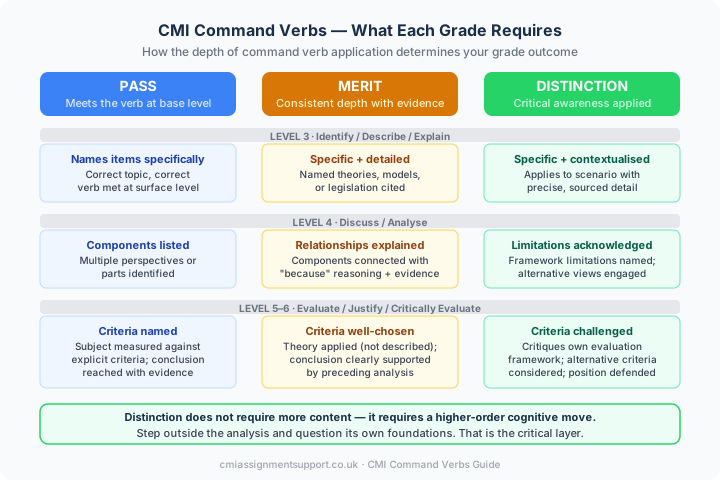
What Does Not Count in CMI 705
Applying Kotter’s 8 steps to a change scenario: Using Kotter as a framework to plan or describe a change programme is Level 5 Evaluate work. CMI 705 requires Critical Analysis of Kotter as a theoretical model â its evidence base, its assumptions, its limitations in complex organisational contexts.
Treating resistance as a communication problem: “People resist change because they don’t understand it” is a Level 5 framing. At Level 7, resistance is examined as a systemic, political, and cultural phenomenon. The strategic leader’s response is structural and cultural, not communicative.
Conflating change management with change leadership: Change management is the operational coordination of change activities â workstreams, milestones, communications plans. Change leadership is the strategic, cultural, and political work of creating the conditions for change at organisational scale. CMI 705 concerns change leadership, not change management.
AC3 as a brief conclusion: Sustaining change and building resilience are substantive Evaluate criteria. One or two paragraphs noting that embedding change requires leadership commitment does not satisfy AC3.
Why CMI 705 Assignments Are Referred â The Most Common Mistakes
1. Kotter applied rather than Critically Analysed The most common referral cause. Kotter’s 8 steps are described and applied to the change scenario as a prescription. The empirical limitations, the stepped-process assumptions, and the complexity theory challenge are absent.
2. Level 5 scope and frameworks Analysis addresses a departmental change at operational management level rather than an organisational transformation at strategic leadership level. Frameworks appropriate to Level 5 (ADKAR at individual level, Kotter as a project plan) are used without the Critically Analytical engagement Level 7 requires.
3. Resistance framed as a communication issue Resistance managed through communication plans and engagement strategies rather than examined as a systemic, political, and cultural phenomenon requiring structural and cultural intervention.
4. No complexity theory engagement The most significant theoretical challenge to planned change models is absent from AC1. Without complexity theory, the Critical Analysis of change frameworks remains within the planned change paradigm rather than challenging its foundations.
5. AC3 underdeveloped Sustaining change receives one or two paragraphs after AC1 and AC2 consume the word count. Organisational resilience â Weick and Sutcliffe, HRO principles, adaptive capacity â requires full Evaluate treatment.
What Separates a Merit from a Distinction in CMI 705?
At Merit, all three Assessment Criteria are addressed at the correct depth. AC1 Critically Analyses Kotter, Lewin, and ADKAR with peer-reviewed evidence, theoretical limitations acknowledged, and complexity theory introduced as a challenge to planned change assumptions. AC2 Critically Analyses resistance at systemic and political scale, not just as a communication challenge. AC3 Evaluates sustaining change and organisational resilience with Weick and Sutcliffe and specific governance and cultural conditions identified. 15+ peer-reviewed sources. Strategic scope throughout.
At Distinction, the response adds:
- Integrates complexity theory into AC2 â if change in complex systems is emergent rather than planned (Stacey), the strategic leader’s role in managing resistance and building change capability must shift from designing and implementing to facilitating and enabling. The Distinction response examines what this shift requires of the strategic leader â epistemic humility, participative design, sense-making investment â and defends it against the planned change alternative
- Connects AC1 to AC3 analytically â the limitation of Lewin’s refreezing concept (AC1) directly informs the evaluation of how change is sustained (AC3). If refreezing is a misapplication of Lewin’s intent and stability is an illusion in complex organisations, then sustaining change is better conceptualised as building adaptive capacity (Weick) than as anchoring a fixed new state (Kotter Step 8)
- Engages the wellbeing dimension â at NHS and public sector scale, the human cost of sustained strategic change â change fatigue, burnout, moral injury in clinical and professional staff â is a legitimate governance concern at board level. The Distinction response acknowledges this dimension and evaluates what the strategic leader’s responsibility is for the wellbeing impact of transformational change
- Synthesises a defended change leadership approach â produces a specific, argued position on which combination of change theory and change leadership practice best serves the defined organisational context under the specific conditions of complexity and resistance identified in AC1 and AC2
CMI 705 Assignment Help â Senior Strategic Writers
Full CMI 705 writing service â A complete strategic paper: change frameworks Critically Analysed (AC1), resistance management and change capability at strategic scale Critically Analysed (AC2), sustaining change and organisational resilience Evaluated (AC3). 15â20 peer-reviewed sources. Board-level strategic recommendations. View CMI assignment writing service
CMI 705 tutoring â We plan your strategic paper structure, guide your Critical Analysis approach for AC1 and AC2 â specifically helping you engage complexity theory and the limitations of Kotter â and provide feedback on your draft. View CMI assignment tutoring
CMI 705 resubmission support â We review your assessor feedback, identify where Kotter was applied rather than Critically Analysed and where AC3 was underdeveloped, and rewrite to Level 7 standard. WhatsApp your submission and feedback.
WhatsApp us with your CMI 705 brief for an immediate quote from a senior strategic writer.
Related CMI Level 7 Units
CMI 701 â Strategic Leadership â adaptive leadership (Heifetz and Laurie) introduced in 701 is the strategic leadership model most directly relevant to leading complex organisational change. The connection between adaptive change leadership and the complexity theory challenge to planned change models in 705 is a high-value analytical bridge between the two units.
CMI 704 â Developing Organisational Strategy â the strategic direction developed in 704 is implemented through the change leadership examined in 705. The two units form the strategy development (704) and strategy execution (705) pair of the Level 7 Diploma.
CMI 702 â Leading and Developing People â building the organisational capability for change (702 â learning organisation, HPWS, psychological safety) is a prerequisite for effective strategic change leadership (705). The double-loop learning conditions created in 702 are the cultural foundation on which change in 705 succeeds or fails.
Return to the full unit list: CMI Level 7 Assignment Help â All 17 Units
FAQ â CMI 705 Assignment Help
What is CMI Unit 705? CMI Unit 705 â Leading Strategic Change covers critical analysis of strategic change leadership frameworks (Kotter, Lewin, ADKAR, complexity theory â AC1), critical analysis of the strategic leader’s role in managing resistance and building change capability at organisational scale (AC2), and evaluation of approaches to sustaining strategic change and building organisational resilience (AC3). Assessed as a strategic paper of 5,000â6,000 words.
How is CMI 705 different from CMI Level 5 change management? CMI Level 5 Unit 512 applies Kotter and Lewin to an organisational change at Evaluate depth. CMI 705 Critically Analyses change leadership at the scale of full organisational transformation â complexity theory challenge to planned change models, political and systemic dimensions of resistance, board-level change governance, and organisational resilience. The scope, command verb, and source standard are categorically different.
Which frameworks are covered in CMI 705? The core frameworks for AC1 are Kotter’s 8-Step Model (1996), Lewin’s Force Field Analysis and freeze model (1951), ADKAR (Prosci), and complexity theory (Stacey, 1996, 2001). AC2 draws on resistance theory, Kanter’s change leadership roles, and Edmondson’s psychological safety in change. AC3 draws on Weick and Sutcliffe’s high reliability organisation framework and the conditions for cultural embedding of change (Schein).
What does Critically Analyse mean for change frameworks in CMI 705? For each framework: examine its empirical evidence base (is Kotter empirically validated?), identify the assumptions it makes about how organisations work (can planned change manage complexity?), engage with the research that challenges those assumptions (Hughes on Kotter, Stacey on complexity), and synthesise a defended position on which approach best serves strategic change leadership in the defined organisational context.
What does AC3 require in CMI 705? AC3 uses Evaluate â not Critically Analyse â and requires a thorough evaluation of how strategic change is sustained beyond initial implementation, and how the organisation builds adaptive resilience for future change. This includes structural alignment, cultural embedding (Schein), high reliability organisation principles (Weick and Sutcliffe), and the governance conditions that hold change accountable at board level.
Can you help with a CMI 705 resubmission? Yes. The most common CMI 705 referral causes are Kotter applied as a framework to follow rather than Critically Analysed as a model with limitations, absence of complexity theory in AC1, resistance framed as a communication problem rather than a systemic and political phenomenon, and AC3 underdeveloped. We review your assessor feedback and rewrite only the sections that need to change.
CMI Unit 705 Assignment Help â expert strategic papers for Leading Strategic Change. Senior UK writers with organisational transformation experience. Critically Analytical depth, complexity theory, Kotter critiqued. WhatsApp for a free quote.