CMI 704 Assignment Help â Developing Organisational Strategy
CMI Unit 704 â Developing Organisational Strategy is the third most-requested Level 7 unit and the strategic analysis core of the Diploma. It requires the student to critically analyse the external environment in which the organisation operates, critically analyse the internal capabilities that differentiate the organisation, and develop and justify a strategic direction that connects environmental opportunities and threats to organisational strengths and limitations. Assignments are submitted as strategic papers of 5,000â6,500 words, assessed using Critically Analyse and the Develop command verb, with 15â20 peer-reviewed sources.
CMI 704 is the unit where strategic frameworks â Porter’s Five Forces, PESTLE, the Resource-Based View, the Ansoff Matrix â must be engaged at Critically Analytical depth, not applied as checklists. The distinction between applying a framework mechanically and Critically Analysing it is the most significant academic gap in CMI 704 submissions, and the most common source of referral at Level 7.
Every CMI 704 assignment we deliver is written by a writer with direct strategic planning, competitive analysis, or organisational strategy experience at director or executive level â the professional context from which strategy development is a real decision, not an academic exercise.
UNIT INFO BADGE ROW â Place below H1 intro, above first H2
Alt text: UNIT INFO BADGE ROW â Place below H1 intro, above first H2
Get CMI 704 Assignment Help on WhatsApp â Senior Strategic Writers
Send your unit brief, assignment question, and deadline for an immediate response.
What Is CMI Unit 704 and What Does It Cover?
CMI Unit 704 â Developing Organisational Strategy addresses the central strategic leadership responsibility: analysing the environment and the organisation’s own capabilities, and developing a coherent strategic direction that positions the organisation for sustained competitive advantage. It is the most directly strategy-focused unit at Level 7 â where other units examine leadership, culture, change, and risk, Unit 704 examines the analytical and decision-making process through which strategy is actually developed.
The unit is assessed against three Assessment Criteria:
- AC1 â Critically analyse the external environment to identify strategic opportunities and threats
- AC2 â Critically analyse internal organisational capabilities to identify strategic strengths and limitations
- AC3 â Develop and justify a strategic direction aligned to organisational capabilities and market context
AC1 and AC2 together produce the strategic analysis â the systematic examination of where the organisation stands relative to its environment. AC3 produces the strategic direction â the original, justified strategic recommendation that follows from that analysis. The assessor expects AC3 to be a genuine strategic synthesis, not a generic strategy description applied to the organisation’s context.
CMI 704 Assessment Criteria â What the Assessor Is Marking
AC1 â Critically analyse the external environment
External analysis at Level 7 requires more than a PESTLE scan and a Porter’s Five Forces diagram. It requires critical engagement with which environmental factors are most strategically significant, how they interact with each other, how stable or volatile the competitive environment is, and what the limitations of the chosen analytical frameworks are. A Critical Analysis of the external environment identifies the two or three factors that most decisively shape the organisation’s strategic context and examines their implications with empirical specificity.
AC2 â Critically analyse internal organisational capabilities
Internal analysis at Level 7 requires the Resource-Based View and the VRIO framework applied to the specific organisation. Which of its resources and capabilities are Valuable (do they add value to customers?), Rare (do competitors have them?), Inimitable (can competitors replicate them?), and Organised (does the organisation deploy them effectively?)? The Critical Analysis must go further â examining whether the organisation’s capabilities are dynamically capable of adapting as the environment changes, or whether they are core rigidities that create strategic lock-in.
AC3 â Develop and justify a strategic direction
AC3 uses Develop rather than Critically Analyse â the task is to produce an original strategic recommendation. That recommendation must be: directly grounded in the AC1 and AC2 analysis (the strategy must follow logically from the environmental and capability findings), evaluated against strategic alternatives (why this direction rather than alternatives?), justified with evidence (what research or case study evidence supports this strategic approach?), and presented at organisational scope with governance and resource implications.
What CMI 704 Assignments Require â Format, Word Count, and Academic Standard
Word count: 5,000â6,500 words per your training provider’s specification.
Academic sources: 15â20 peer-reviewed sources. Strategy research requires engagement with Strategic Management Journal, Academy of Management Review, Harvard Business Review (for applied strategy), Journal of Management Studies, and sector-specific research. Porter’s original Five Forces paper (1979, 1980), Barney’s RBV paper (1991), Teece, Pisano and Shuen on dynamic capabilities (1997), and Kaplan and Norton on the Balanced Scorecard (1992) should be cited directly where these frameworks are applied â not through textbook summaries.
CMI 704 Strategic Paper â Section by Section
| Section | Purpose | CMI 704 Notes |
|---|---|---|
| Title Page | Unit details, student information | Include “Unit 704 â Developing Organisational Strategy” |
| Executive Summary | Standalone strategic summary | 300â400 words. Summarises the external analysis findings, internal capability assessment, and recommended strategic direction â at board paper standard. |
| Contents Page | Section headings | â |
| Introduction | Organisational context, strategic scope | 300â400 words. Define the organisation â sector, size, current strategic position. Establish the strategic context and the analytical question the paper addresses. |
| AC1 Section | Critically analyse external environment | PESTLE (selected high-priority factors), Porter’s Five Forces â both Critically Analysed |
| AC2 Section | Critically analyse internal capabilities | RBV, VRIO â applied to specific organisational resources and capabilities; dynamic capabilities framework |
| AC3 Section | Develop and justify strategic direction | Ansoff positioning, Generic Strategies â strategic direction justified against AC1/AC2 analysis with alternatives evaluated |
| Conclusion | Strategic synthesis | 250â350 words â the strategic argument summarised |
| Strategic Recommendations | 2â3 board-level recommendations | Strategic options with resource, governance, and implementation implications |
| Bibliography | Harvard references | 15â20 peer-reviewed sources minimum |
Key Frameworks in CMI Unit 704
PESTLE â External Environment Analysis
PESTLE â Political, Economic, Social, Technological, Legal, Environmental â provides a structured framework for scanning the macro-environment. At Level 7, PESTLE is not a list of factors under each heading â it is a prioritised analysis of the factors most material to the organisation’s strategic context.
How to Critically Analyse PESTLE in CMI 704 AC1: The critical failure with PESTLE at Level 7 is treating it as a comprehensive list rather than a prioritised strategic analysis. A PESTLE that gives equal weight to 30 factors across six categories does not help a strategic leader make decisions â it creates information noise. The Critical Analysis selects the two or three factors with the highest strategic significance for the specific organisation, examines them with empirical specificity (data, research evidence, sector analysis), identifies how they interact (a technological shift may simultaneously create political and economic implications), and draws a strategic conclusion about the opportunities and threats they present.
Limitations to Critically Analyse: PESTLE is a static snapshot â it captures the environment at a point in time but provides no mechanism for tracking how factors are changing or how rapidly. It also lacks a framework for assessing the relative importance of factors (all six categories appear equally weighted). Scenario planning or STEEP analysis (no Legal category) are sometimes used as complementary or alternative approaches.
Porter’s Five Forces â Competitive Industry Analysis
Michael Porter (1979, 1980) identified five competitive forces that determine the long-run profit potential of an industry: the threat of new entrants, the bargaining power of buyers, the bargaining power of suppliers, the threat of substitute products or services, and the intensity of competitive rivalry. Together, these forces determine the structure of competitive dynamics in an industry and the attractiveness of that industry for participants.
PORTER'S FIVE FORCES DIAGRAM â Place after Porter's Five Forces explanation, before RBV H3
Alt text: PORTER'S FIVE FORCES DIAGRAM â Place after Porter's Five Forces explanation, before RBV H3
How to Critically Analyse Porter in CMI 704 AC1: The Critical Analysis must go beyond rating each force as high or low. It must examine: which force or forces are most constraining for this specific organisation in this specific market? How are the forces changing â is buyer power increasing as digitisation reduces switching costs? Are new entrants emerging from adjacent industries? What does the aggregate force configuration mean for the organisation’s strategic position and its ability to generate sustainable returns?
Limitations to Critically Analyse: Porter’s Five Forces has been criticised for its assumption of a relatively stable industry structure â in disrupted, rapidly evolving industries (digital platforms, healthcare systems undergoing policy reform, energy markets in transition), the five-forces structure can change faster than strategy can respond. The model also underweights complementors (organisations whose products or services increase the value of the organisation’s own offer â Brandenburger and Nalebuff, 1996) and collaborative relationships that blur the competitive boundaries Porter assumes. At Level 7, engaging these limitations demonstrates the critical engagement assessors require.
Resource-Based View and VRIO â Internal Capability Analysis
Barney (1991) proposed that sustainable competitive advantage arises not from the external competitive environment (as Porter emphasises) but from the organisation’s internal resources and capabilities â specifically those that are Valuable, Rare, Inimitable, and Organised (the VRIO framework, refined by Barney and Hesterly).
Valuable: Does the resource or capability enable the organisation to exploit opportunities or neutralise threats in its environment? A resource that is not aligned to the current strategic context has no competitive value regardless of its internal characteristics.
Rare: Do competitors possess this resource or capability? A resource shared across all competitors in an industry provides competitive parity but not advantage.
Inimitable: Can competitors replicate or acquire this resource or capability? Inimitability arises from historical path dependence (the resource was built through a unique organisational history), causal ambiguity (it is unclear exactly what produces the capability), and social complexity (the resource is embedded in relationships, culture, or knowledge that cannot be transferred).
Organised: Is the organisation structured and managed to exploit the resource? A valuable, rare, and inimitable resource that the organisation fails to deploy effectively provides no competitive advantage.
How to Critically Analyse RBV in CMI 704 AC2: Apply VRIO specifically to the organisation’s named resources and capabilities. The analysis must be concrete â not “the organisation has strong human capital” but “the organisation’s NHS-qualified clinical management team represents a capability that is valuable (critical for service delivery quality), rare (accumulated through 15 years of retention and development investment), inimitable (embedded in clinical-management relationships and institutional knowledge), and organised (deployed through clinical governance structures that give the team decision-making authority aligned to their expertise).”
Dynamic capabilities â Teece, Pisano and Shuen (1997): Static RBV analysis identifies current capabilities but does not examine whether the organisation can adapt those capabilities as the environment changes. Dynamic capabilities â the ability to sense opportunities, seize them, and reconfigure the resource base in response â address this gap. For strategic leaders operating in volatile environments, dynamic capability is arguably the most strategically important organisational capacity to build and sustain.
Limitation to Critically Analyse: RBV has been criticised for its tautological tendency â resources are defined as competitively valuable because they produce competitive advantage, and competitive advantage is attributed to resources because they are valuable. The empirical measurement of resources and capabilities is also deeply challenging â the most strategically valuable capabilities (culture, knowledge, relationships) are the hardest to quantify and study. Foss and Knott (various) and Priem and Butler (2001) provide the most substantive critiques for engagement at Level 7.
Ansoff Matrix â Strategic Direction Options
Igor Ansoff (1957) provided a simple but analytically powerful framework for categorising strategic growth directions. The Ansoff Matrix maps four strategic options against two dimensions â existing vs new markets, and existing vs new products/services:
- Market penetration (existing market, existing products): grow by taking share from competitors or increasing frequency of purchase. Lowest risk. Appropriate when the market is growing or when the organisation has under-exploited its current market position.
- Market development (new market, existing products): grow by entering new geographic or demographic markets with existing offerings. Moderate risk. Appropriate when the organisation’s current offer has proved its value and the new market is accessible.
- Product development (existing market, new products): grow by developing new offerings for existing customers. Moderate risk. Requires strong customer knowledge and product development capability.
- Diversification (new market, new products): grow by entering entirely new markets with new offerings. Highest risk. Related diversification (new market or product adjacent to existing business) is lower risk than unrelated diversification.
ANSOFF MATRIX â Place after Ansoff explanation, before Porter's Generic Strategies H3
Alt text: ANSOFF MATRIX â Place after Ansoff explanation, before Porter's Generic Strategies H3
How to use in CMI 704 AC3: The Ansoff Matrix positions the recommended strategic direction against alternatives. The justification in AC3 must explain why the recommended direction (e.g., market development) is preferable to the alternatives (e.g., product development or diversification) given the specific AC1 environmental analysis and AC2 capability assessment. The strategy must be internally consistent â an organisation with strong existing product capabilities and limited market development experience should not recommend diversification without acknowledging the capability gap that makes it high risk.
Porter’s Generic Strategies â Competitive Positioning
Porter’s three generic strategies describe the basis on which a firm competes in its industry: cost leadership (the lowest-cost producer in the industry), differentiation (offering something uniquely valued by customers for which they will pay a premium), and focus (serving a narrow market segment with either cost leadership or differentiation). A firm that fails to choose between cost leadership and differentiation is “stuck in the middle” â neither achieving the cost advantage of the cost leader nor the premium of the differentiator, and therefore unable to generate superior returns.
Critically Analyse in CMI 704 AC3: Porter’s generic strategies framework has been criticised for its binary logic â the mutual exclusivity of cost leadership and differentiation has been challenged empirically. Research by Kim and Mauborgne (Blue Ocean Strategy, 2005) and others demonstrates that organisations can simultaneously offer differentiated value at low relative cost through value innovation. The “stuck in the middle” trap also assumes stable industry structures â in disrupted markets, hybrid competitive positions may be the appropriate strategic response. A Critical Analysis in AC3 acknowledges these challenges while evaluating which competitive positioning best fits the AC1/AC2 analysis.
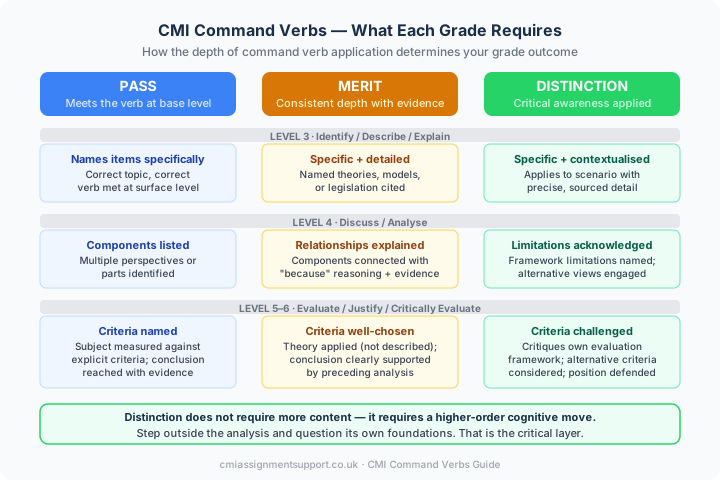
What Critically Analyse and Develop Require in CMI 704
For AC1 and AC2 â Critically Analyse: The five requirements from Unit 701 apply: decompose the strategic concept, apply peer-reviewed empirical evidence, identify limitations, engage competing perspectives, synthesise an original position. For CMI 704, this means:
- Not listing PESTLE factors â selecting and analysing the two or three most strategically significant
- Not rating Porter’s forces â examining which are most constraining and how they are changing
- Not describing VRIO â applying it to named organisational resources with specific evidence of value, rarity, and inimitability
For AC3 â Develop: Develop requires producing an original strategic recommendation â not identifying a generic strategy from a textbook. The recommendation must:
- Follow logically from the AC1 and AC2 analysis
- Evaluate strategic alternatives and justify the recommended direction against them
- Be supported by evidence from strategy research or comparable organisational cases
- Address implementation implications at board scope â resources required, governance needed, risks to mitigate
What Does Not Count in CMI 704
A PESTLE list without strategic prioritisation: Six categories with three or four factors each, rated as opportunities or threats with no evidence of which matter most strategically, does not satisfy AC1. Strategic significance must be argued, not assumed.
Porter’s Five Forces applied as a checklist: Rating each force as high or low without examining which forces are most constraining, how they interact, or what their strategic implications are for this specific organisation is mechanical application â not Critical Analysis.
VRIO without specificity: “The organisation has strong human capital” is not a VRIO analysis. Name the specific capability, identify what makes it valuable, provide evidence of its rarity and inimitability, and examine whether the organisation is organised to exploit it effectively.
AC3 strategy disconnected from AC1 and AC2: The recommended strategic direction must follow logically from the external and internal analysis. A strategy that does not connect to the most significant environmental opportunities or that exceeds the organisation’s capability base as identified in AC2 is strategically incoherent.
Why CMI 704 Assignments Are Referred â The Most Common Mistakes
1. Frameworks applied mechanically, not Critically Analysed PESTLE and Porter’s Five Forces used as templates to complete rather than as analytical frameworks to engage critically. No limitations examined, no prioritisation of significance, no competing perspectives engaged.
2. RBV described without VRIO applied to specific resources The VRIO framework is introduced but applied generically â “the organisation has valuable human resources” â rather than specifically â examining a named capability against each VRIO criterion with evidence.
3. AC3 strategy not grounded in AC1/AC2 analysis The strategic recommendation is made before or independent of the analysis. The strategy does not emerge from the environmental and capability findings â it is imposed on them. The assessor expects a logical thread from AC1 through AC2 to AC3.
4. No dynamic capabilities engagement Static RBV analysis (what capabilities exist now) without dynamic capability analysis (can the organisation adapt those capabilities as the environment changes?) misses the most strategically important capability question for organisations in volatile environments.
5. Operational scope Strategic analysis conducted at departmental or project level rather than at organisational or competitive level. The unit requires organisation-wide strategy development, not project planning.
What Separates a Merit from a Distinction in CMI 704?
At Merit, all three Assessment Criteria are addressed at the correct depth. AC1 Critically Analyses the external environment â PESTLE prioritised with evidence, Porter’s Five Forces with critical engagement of which forces are most constraining. AC2 Critically Analyses internal capabilities â RBV/VRIO applied to named resources with specificity, dynamic capabilities acknowledged. AC3 develops a justified strategic direction connected to the AC1/AC2 analysis, evaluated against alternatives. 15+ peer-reviewed sources cited.
At Distinction, the response adds:
- Integrates AC1 and AC2 analytically before AC3 â the most strategically significant environmental factor (AC1) connects directly to the most relevant organisational capability or gap (AC2). The strategy in AC3 emerges from this intersection, not from the frameworks independently
- Critiques frameworks at depth â Porter’s Five Forces limitations (complementors, collaborative relationships, industry disruption) engaged with specific evidence. RBV tautology critique addressed. Dynamic capabilities applied to evaluate whether the organisation’s current capabilities will remain sources of advantage as the environment evolves
- Evaluates strategic alternatives before recommending â uses Ansoff to position the recommended direction against alternatives and provides evidence-based justification for why alternatives are less appropriate
- Strategic recommendations address governance â the Distinction-level AC3 recommendation identifies not just what strategy but who decides, who resources it, what governance structure oversees it, and what risk mitigants are required
CMI 704 Assignment Help â Senior Strategic Writers
Full CMI 704 writing service â A complete strategic paper: external environment Critically Analysed (PESTLE, Porter, AC1), internal capabilities Critically Analysed (RBV, VRIO, dynamic capabilities, AC2), and a strategic direction developed and justified against alternatives (AC3). 15â20 peer-reviewed sources. Board-level strategic recommendations. View CMI assignment writing service
CMI 704 tutoring â We plan your strategic analysis framework, guide your Critical Analysis approach for AC1 and AC2, and help you develop a justified strategic direction for AC3 that connects to your analysis. View CMI assignment tutoring
CMI 704 resubmission support â We review your assessor feedback, identify where frameworks were applied mechanically rather than Critically Analysed, and restructure the paper to Level 7 standard. WhatsApp us with your submission and feedback.
WhatsApp us with your CMI 704 brief for an immediate quote from a senior strategic writer.
Related CMI Level 7 Units
CMI 701 â Strategic Leadership â the strategic leadership approach examined in 701 directly shapes how strategy is developed in 704. Upper echelons theory (Hambrick and Mason) connects the strategic leader’s values and cognitive base to the strategic choices the organisation makes.
CMI 702 â Leading and Developing People â organisational capability (702) is the internal resource base that the VRIO analysis in 704 AC2 examines. The capabilities built through talent and capability strategy in 702 become the sources of sustainable competitive advantage in 704.
CMI 705 â Leading Strategic Change â the strategic direction developed in 704 must be implemented through the strategic change process examined in 705. The two units are the strategy development and strategy execution pair of the Level 7 Diploma.
CMI 708 â Strategic Risk Management â the strategic risks inherent in the direction recommended in 704 are the subject of the risk governance analysis in 708.
Return to the full unit list: CMI Level 7 Assignment Help â All 17 Units
FAQ â CMI 704 Assignment Help
What is CMI Unit 704? CMI Unit 704 â Developing Organisational Strategy covers critical analysis of the external environment (PESTLE, Porter’s Five Forces â AC1), critical analysis of internal organisational capabilities (Resource-Based View, VRIO, dynamic capabilities â AC2), and the development and justification of a strategic direction aligned to environmental and capability analysis (AC3). It is assessed as a strategic paper of 5,000â6,500 words.
Which strategic frameworks are covered in CMI 704? For AC1: PESTLE and Porter’s Five Forces (1979, 1980). For AC2: the Resource-Based View (Barney, 1991), the VRIO framework, and dynamic capabilities (Teece, Pisano and Shuen, 1997). For AC3: Ansoff Matrix, Porter’s Generic Strategies, and the Balanced Scorecard (Kaplan and Norton, 1992). All must be Critically Analysed â not applied as checklists.
What is the difference between PESTLE and Porter’s Five Forces? PESTLE analyses the macro-environment â the political, economic, social, technological, legal, and environmental factors that affect all organisations in a given context. Porter’s Five Forces analyses the competitive dynamics within the industry â the structural forces that determine how value is distributed among competitors, suppliers, and buyers. Both are required for a complete external analysis in CMI 704 AC1.
What does AC3 require in CMI 704? AC3 uses the Develop command verb â not Critically Analyse. It requires the student to produce an original strategic recommendation that: emerges logically from the AC1 and AC2 analysis, is evaluated against strategic alternatives, is justified with evidence from strategy research or comparable cases, and is presented with governance and resource implications at board scope.
What is the Resource-Based View and how is it used in CMI 704? The Resource-Based View (Barney, 1991) proposes that sustainable competitive advantage comes from internal resources and capabilities rather than external competitive positioning. The VRIO framework applies four criteria to each resource: Valuable, Rare, Inimitable, and Organised. In CMI 704 AC2, VRIO is applied to specific named organisational resources â not generic descriptions â to identify which capabilities provide genuine competitive advantage.
Can you help with a CMI 704 resubmission? Yes. The most common CMI 704 referral causes are frameworks applied mechanically (PESTLE listed, Porter rated) rather than Critically Analysed, VRIO applied generically rather than to specific named resources, and AC3 strategy not logically grounded in the AC1 and AC2 analysis. We review your assessor feedback and rewrite only the sections that need to change.
CMI Unit 704 Assignment Help â expert strategic papers for Developing Organisational Strategy. Senior UK writers with strategic planning and competitive analysis experience. Porter, RBV, Critically Analyse depth. WhatsApp for a free quote.