CMI 702 Assignment Help — Leading and Developing People to Optimise Performance
CMI Unit 702 — Leading and Developing People to Optimise Performance is the second most-requested Level 7 unit and the direct companion to Unit 701. Where Unit 701 examines strategic leadership as a practice and a philosophy, Unit 702 examines what strategic leaders do to develop the human capability of the organisation — talent strategy, succession planning, building the conditions for high performance at enterprise scale, and the cultural architecture the strategic leader creates and sustains. Assignments are submitted as strategic papers of 5,000–6,000 words, assessed at Critically Analyse depth with 15–20 peer-reviewed sources.
The critical distinction that students must establish from the outset: CMI 702 is not a Level 5 people management unit at a higher word count. Level 5 units 502 and 503 cover team-level people development — Tuckman’s stages, Belbin’s roles, Maslow and Herzberg applied to individual motivation. CMI 702 operates at enterprise level — how the strategic leader designs talent pipelines, builds succession capability, creates the organisational conditions for high performance across the entire workforce, and shapes the learning culture that determines whether the organisation can adapt and grow.
Every CMI 702 assignment we deliver is written by a senior writer with strategic HR, organisational development, or executive leadership experience — the professional context from which talent strategy and organisational capability look like strategic decisions, not management tasks.
UNIT INFO BADGE ROW — Place below H1 intro, above first H2
Alt text: UNIT INFO BADGE ROW — Place below H1 intro, above first H2
Get CMI 702 Assignment Help on WhatsApp — Senior Strategic Writers
Send your unit brief, assignment question, and deadline for an immediate response.
What Is CMI Unit 702 and What Does It Cover?
CMI Unit 702 — Leading and Developing People to Optimise Performance addresses the strategic leader’s responsibility for the human capability of the organisation. In complex organisations — NHS trusts, multi-site corporations, public bodies, professional services firms — the strategic leader’s most consequential long-term decisions concern who is in the talent pipeline, how organisational capability is built and sustained, what high performance means at enterprise scale, and what cultural conditions make it possible.
These are not HR decisions delegated to a people function. At Level 7, the strategic leader owns the talent and capability agenda — setting the strategic direction, making the pivotal investment decisions, and creating the cultural architecture in which high performance is possible or impossible.
The unit is assessed against three Assessment Criteria:
- AC1 — Critically analyse approaches to strategic talent management and succession planning
- AC2 — Critically analyse approaches to developing organisational capability and workforce performance
- AC3 — Evaluate the strategic leader’s role in creating a high-performance culture
AC1 examines the frameworks through which organisations identify, develop, and retain the talent critical to strategic success, and how leaders plan for continuity in key roles. AC2 examines enterprise-level capability development — how organisations build the collective knowledge, skills, and behaviours required for sustained high performance. AC3 evaluates the strategic leader’s specific contribution to creating the cultural conditions in which high performance is achieved and sustained.
CMI 702 Assessment Criteria — What the Assessor Is Marking
AC1 — Critically analyse approaches to strategic talent management and succession planning
Strategic talent management is not the management of the training budget or the annual appraisal cycle. It is the identification of the roles and individuals most critical to the organisation’s strategic success, the deliberate development of talent for those roles, and the management of the talent pipeline as a strategic asset. AC1 requires Critically Analytical engagement with the theoretical frameworks — Collings and Mellahi’s pivotal positions model, the 9-box grid, replacement planning vs succession management — examining their empirical evidence bases, their assumptions, their limitations, and their application in complex organisational contexts.
AC2 — Critically analyse approaches to developing organisational capability and workforce performance
Organisational capability is what the organisation as a whole can do — its collective competencies, its learning systems, its performance architecture. AC2 requires critical analysis of the frameworks through which strategic leaders develop this capability: the learning organisation (Senge, Argyris and Schön), high-performance work systems (HPWS), human capital theory, and Ulrich and Smallwood’s capability framework. The analysis must engage with the evidence base and limitations of each approach, and produce an original synthesis on which approaches best develop sustainable organisational capability in the defined strategic context.
AC3 — Evaluate the strategic leader’s role in creating a high-performance culture
Note that AC3 uses Evaluate — the Level 5 command verb — rather than Critically Analyse. It requires a thorough evaluation of how the strategic leader specifically creates, sustains, and transforms a high-performance culture: through Schein’s primary embedding mechanisms (what the leader pays attention to, how they allocate resources, what behaviours they model), through psychological safety at organisational scale (Edmondson), through HPWS cultural conditions, and through the governance mechanisms that hold the culture accountable.
What CMI 702 Assignments Require — Format, Word Count, and Academic Standard
Word count: 5,000–6,000 words, per your training provider’s specification.
Academic sources: 15–20 peer-reviewed sources, with an emphasis on strategic HRM, organisational behaviour, and management journals — Human Resource Management Journal, Academy of Management Journal, Journal of Applied Psychology, Strategic Management Journal. Textbooks are insufficient as primary sources at Level 7.
CMI 702 Strategic Paper — Section by Section
| Section | Purpose | CMI 702 Notes |
|---|---|---|
| Title Page | Unit details, student information | Include “Unit 702 — Leading and Developing People to Optimise Performance” |
| Executive Summary | Standalone strategic summary — written last | 300–400 words. Board-briefing level — summarises talent strategy findings and organisational capability recommendations. |
| Contents Page | Section headings | — |
| Introduction | Organisational context, strategic scope | 300–400 words. Define the organisation — sector, size, strategic challenge. Establish why talent and capability are strategic priorities in this context. |
| AC1 Section | Critically analyse talent management and succession | Pivotal positions, 9-box grid, succession vs replacement planning — Critically Analytical depth with peer-reviewed evidence |
| AC2 Section | Critically analyse capability development approaches | Learning organisation, HPWS, human capital theory, Ulrich and Smallwood — competing frameworks placed in dialogue |
| AC3 Section | Evaluate strategic leader role in high-performance culture | Schein’s embedding mechanisms, Edmondson’s psychological safety, HPWS cultural conditions |
| Conclusion | Original strategic synthesis | 250–350 words — defended position on talent and capability strategy |
| Strategic Recommendations | 2–3 organisational-level recommendations | Board scope — talent pipeline, capability investment, cultural architecture |
| Bibliography | Harvard references | 15–20 peer-reviewed sources minimum |
Key Frameworks in CMI Unit 702
Strategic Talent Management — Collings and Mellahi
Collings and Mellahi (2009) define strategic talent management as the systematic identification of pivotal positions that differentially contribute to sustainable competitive advantage, the development of a talent pool of high-potential employees to fill these roles, and the design of a differentiated human resource architecture to facilitate filling these roles.
The pivotal positions concept is the model’s most practically significant contribution. Not all roles in an organisation are equally strategic — some positions have disproportionate impact on the organisation’s ability to execute its strategy. The strategic leader’s talent management responsibility is concentrated on these positions: identifying them correctly, building the talent pipeline to fill them, and retaining the individuals who occupy them.
Critically Analyse in CMI 702 AC1: Collings and Mellahi’s model has been criticised for its elitist assumption — the concentration of strategic investment in a small cohort of “talent” at the expense of the broader workforce. Pfeffer (2001) argues that this creates a two-tier workforce with damaging consequences for organisational culture and middle-management performance. A Critical Analysis engages with this tension directly: does the pivotal positions approach produce the strategic performance advantage it promises, or does it undermine the collaborative, knowledge-sharing cultures that adaptive organisations require?
Boudreau and Ramstad (2007) — Talentship: A complementary framework that repositions talent decision-making as a strategic management discipline — analogous to finance — with its own logic, analytics, and decision science. Where Collings and Mellahi focus on which positions are pivotal, Boudreau and Ramstad focus on how talent decisions are made and how their strategic value is measured.
Succession Planning — Replacement Planning vs Succession Management
The distinction between replacement planning and succession management is the most important conceptual distinction in AC1.
Replacement planning identifies who would fill a specific role if the current incumbent left tomorrow. It is reactive, position-focused, and produces a “names in boxes” approach to leadership continuity.
Succession management is a proactive, development-focused approach to building leadership pipeline capability — identifying high-potential individuals early, providing stretch assignments and development experiences, building a pool of future-ready leaders across multiple levels rather than naming specific replacements.
How to Critically Analyse the succession debate in CMI 702: The research evidence on succession management effectiveness is mixed. Rothwell (2010) and others argue that formal succession management produces better leadership continuity and organisational performance. But Groysberg, McLean and Nohria (2006) find that “stars” developed internally often underperform when placed in top roles — suggesting that succession management’s assumptions about talent transferability are not always valid.
9-BOX GRID — Place after succession planning section, before Human Capital Theory H3
Alt text: 9-BOX GRID — Place after succession planning section, before Human Capital Theory H3
Human Capital Theory — Becker
Gary Becker (1964) established the theoretical foundation for treating investment in people as investment in productive assets — human capital. Distinguishing between general human capital (skills transferable across employers) and firm-specific human capital (skills valuable only within the current organisation), Becker’s framework provides the economic logic for talent development investment.
Critically Analyse in CMI 702 AC2: Human capital theory has been criticised for its individualist, market-oriented assumptions — treating people as assets to be invested in for return rather than as stakeholders with their own agency and interests. The theory also struggles to account for social capital and organisational capital (knowledge embedded in systems, processes, and culture rather than in individual people).
The Learning Organisation — Senge and Argyris
Peter Senge’s (1990) five disciplines of a learning organisation — personal mastery, mental models, shared vision, team learning, and systems thinking — describe the conditions under which organisations continuously develop their collective capacity to create desired results. Argyris and Schön’s (1978) single-loop and double-loop learning provide a complementary framework: single-loop learning corrects errors within existing assumptions; double-loop learning questions and changes the underlying assumptions themselves.
Strategic relevance for CMI 702: Double-loop learning is the most strategically significant concept for complex organisations facing adaptive challenges. An organisation capable only of single-loop learning can optimise existing strategies but cannot fundamentally rethink its approach when the environment changes.
Limitation to Critically Analyse: Senge’s learning organisation is widely cited but empirically contested. The five disciplines are normatively compelling but difficult to operationalise and measure. Research on whether “learning organisation” interventions actually improve organisational performance is mixed — the construct is diffuse and measurement is problematic (Örtenblad, 2001).
High-Performance Work Systems — Combs et al.
High-performance work systems (HPWS) are bundles of HR practices — selective recruitment, extensive training, performance-contingent compensation, participative decision-making, job enrichment, and information sharing — that, when implemented together, produce performance outcomes significantly greater than any individual practice achieves alone. Combs et al.’s (2006) meta-analysis of 92 studies found that HPWS are associated with a 4.6% increase in return on assets — among the most empirically well-supported HR interventions.
Critically Analyse in CMI 702 AC2: HPWS research is among the strongest in strategic HRM, but the Critical Analysis must engage with its limitations. The “black box” problem — how exactly HPWS produce performance outcomes — remains poorly understood. The assumption that HPWS are universally effective is contested: evidence suggests they are more effective in high-skill, knowledge-intensive work and less effective in low-discretion, process-driven roles.
HPWS PRACTICE BUNDLES DIAGRAM — Place after HPWS section, before Organisational Capability H3
Alt text: HPWS PRACTICE BUNDLES DIAGRAM — Place after HPWS section, before Organisational Capability H3
Organisational Capability — Ulrich and Smallwood
Dave Ulrich and Norm Smallwood (2004) define organisational capability as what the organisation is known for being able to do — its identity in the marketplace. Capabilities such as talent, speed, shared mindset, accountability, collaboration, learning, and innovation are the enduring strengths that outlast any individual leader. The strategic leader’s role is to identify the capabilities that create competitive advantage, invest in them deliberately, and ensure they are embedded in systems, processes, and culture rather than dependent on specific individuals.
Application in CMI 702 AC2: Ulrich and Smallwood’s framework connects talent management (AC1) to organisational capability (AC2) — the goal of talent strategy is not individual development for its own sake but the building of the organisational capabilities that drive strategic performance.
What Critically Analyse Requires in CMI 702
The Critically Analyse command verb applies to AC1 and AC2. The same five requirements from Unit 701 apply — decompose, apply empirical evidence, identify limitations, engage competing perspectives, synthesise an original position — but directed at talent management and capability development frameworks.
Specific to CMI 702: The most common failure is applying these frameworks descriptively — explaining what Senge’s five disciplines are, or what the 9-box grid does — without critically engaging the empirical evidence, the theoretical assumptions, or the competing perspectives.
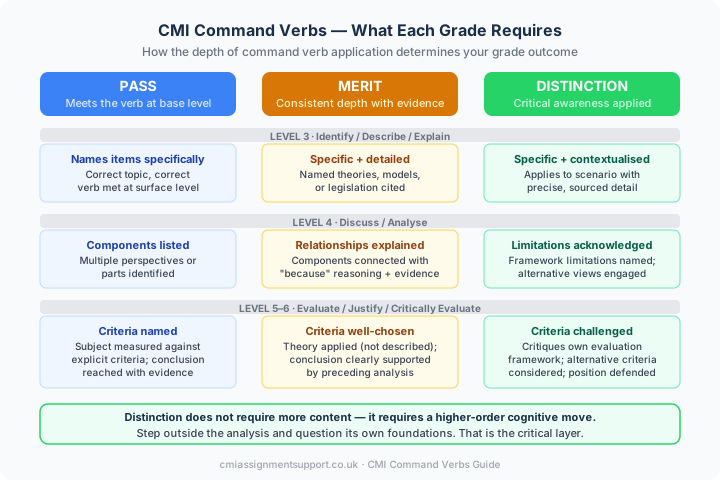
What Does Not Count as Critically Analyse in CMI 702
Applying Level 5 team development frameworks: Tuckman, Belbin, Maslow, and Herzberg are team-level frameworks. Their presence in a CMI 702 submission signals that the student has approached a Level 7 unit with Level 5 analytical tools.
Describing HPWS practices without critical engagement: Listing the six HPWS practices and noting they produce performance outcomes does not satisfy Critically Analyse. The analytical requirement is to examine the evidence base, the black box problem, the conditions under which HPWS effects are strongest, and the implementation challenges.
Succession planning described as a process: Presenting the stages of a succession planning process is description. Critically Analyse requires engagement with the theoretical debate: does succession management actually produce better leadership continuity? Under what conditions? What does the evidence on internal vs external talent say?
Why CMI 702 Assignments Are Referred — The Most Common Mistakes
1. Team-level frameworks applied at enterprise scope The most significant structural error. Using Tuckman, Maslow, or Belbin in a CMI 702 submission applies Level 5 analytical tools to a Level 7 enterprise context.
2. No peer-reviewed evidence Talent management and capability development research requires engagement with SHRM journals, organisational behaviour journals, and empirical studies. Textbook summaries of Senge or Ulrich are not the academic standard required at Level 7.
3. AC1 and AC2 treated as separate topics Talent management (AC1) and organisational capability (AC2) are interconnected — the goal of talent strategy is the building of the organisational capabilities that create strategic advantage.
4. AC3 as a brief conclusion The strategic leader’s role in creating high-performance culture is a substantive Evaluate criterion. Schein’s embedding mechanisms, Edmondson’s psychological safety at scale, and the governance mechanisms through which the strategic leader shapes cultural conditions require full evaluative treatment.
5. Operational scope Analysis addresses departmental training budgets and team performance reviews rather than enterprise talent pipelines and workforce capability strategy.
What Separates a Merit from a Distinction in CMI 702?
At Merit, all three Assessment Criteria are addressed at the correct command verb depth. AC1 Critically Analyses talent management and succession planning with peer-reviewed evidence, theoretical limitations acknowledged, and a defended strategic position. AC2 Critically Analyses at least three capability development frameworks with competing perspectives engaged. AC3 Evaluates the strategic leader’s cultural role with Schein and Edmondson referenced. 15+ peer-reviewed sources cited.
At Distinction, the response adds:
- Integrates AC1 and AC2 analytically — talent management is the input; organisational capability is the output. The Distinction response develops an integrated strategic argument connecting pivotal positions (AC1) to which capabilities must be built (AC2) to the learning conditions required (AC3)
- Engages the elitism critique of talent management — Pfeffer’s argument that exclusive talent investment damages the broader workforce culture is addressed directly
- Critically Analyses psychological safety at scale — Edmondson’s team-level psychological safety research is important but the mechanisms for creating it across large, complex organisations are less well-evidenced
- Synthesises an original capability strategy — produces a specific, defended recommendation on which combination of talent management approach, capability development framework, and cultural architecture best serves the defined organisation
CMI 702 Assignment Help — Senior Strategic Writers
Full CMI 702 writing service — A complete strategic paper addressing all three Assessment Criteria at the correct command verb depth. 15–20 peer-reviewed sources. Strategic recommendations at board scope. View CMI assignment writing service
CMI 702 tutoring — We plan your strategic paper structure, identify peer-reviewed sources required, guide your Critically Analytical approach, and provide feedback on your draft. View CMI assignment tutoring
CMI 702 resubmission support — We review your assessor feedback, identify where team-level frameworks were applied at enterprise scope or Evaluate depth was used instead of Critically Analyse, and rewrite to Level 7 standard.
WhatsApp us with your CMI 702 brief for an immediate quote from a senior strategic writer.
Related CMI Level 7 Units
CMI 701 — Strategic Leadership — the strategic leadership models evaluated in 701 directly shape the talent and capability development approach in 702. A strategic leader who adopts distributed leadership (701) will design talent development systems that build leadership capacity broadly across the organisation.
CMI 704 — Developing Organisational Strategy — organisational capability (702) is a central component of the Resource-Based View of competitive advantage evaluated in 704.
CMI 705 — Leading Strategic Change — building organisational capability for change (702) is a prerequisite for effective strategic change leadership (705). The learning organisation and double-loop learning frameworks in 702 connect directly to the adaptive challenge concept in 705.
Return to the full unit list: CMI Level 7 Assignment Help — All 17 Units
FAQ — CMI 702 Assignment Help
What is CMI Unit 702? CMI Unit 702 — Leading and Developing People to Optimise Performance covers strategic talent management and succession planning (AC1), approaches to developing organisational capability and workforce performance (AC2), and the strategic leader’s role in creating a high-performance culture (AC3). Assessed as a strategic paper of 5,000–6,000 words at Critically Analyse depth.
How is CMI 702 different from CMI Level 5 people management units? CMI Level 5 units 502 and 503 cover team-level people development — Tuckman’s team development model, Belbin’s roles, Maslow and Herzberg. CMI 702 operates at enterprise level — strategic talent pipelines, workforce capability architecture, HPWS, and the cultural conditions created by the strategic leader across the whole organisation.
Which frameworks are covered in CMI 702? The core frameworks are Collings and Mellahi’s pivotal positions model and the 9-box grid (AC1), Senge’s learning organisation, Argyris and Schön’s double-loop learning, HPWS (Combs et al.), human capital theory (Becker), and Ulrich and Smallwood’s organisational capability framework (AC2). Schein’s primary embedding mechanisms and Edmondson’s psychological safety at scale apply to AC3.
What does Critically Analyse mean for CMI 702? For each framework: decompose it, apply peer-reviewed empirical evidence from SHRM and OB journals, identify theoretical limitations and assumptions, place competing frameworks in direct dialogue, and synthesise a defended strategic position on which approach best develops talent and capability in the defined organisational context.
What does AC3 require in CMI 702? AC3 uses Evaluate — not Critically Analyse — and requires a thorough evaluation of the strategic leader’s specific role in creating a high-performance culture, including Schein’s primary embedding mechanisms, Edmondson’s psychological safety conditions at organisational scale, and the HPWS practices that create a high-performance cultural environment.
Can you help with a CMI 702 resubmission? Yes. The most common CMI 702 referral causes are team-level frameworks applied at enterprise scope and AC3 addressed in one or two paragraphs rather than at full Evaluate depth. We review your assessor’s feedback and rewrite only what needs to change.
CMI Unit 702 Assignment Help — expert strategic papers for Leading and Developing People to Optimise Performance. Senior UK writers with strategic HR and executive leadership experience. Critically Analytical depth, 15–20 peer-reviewed sources. WhatsApp for a free quote.